 English
 русский
 Español
 عربى


Solid Color Four-Piece Bed Sheet Set: Soft Comfort, Reliable Quality, and Flexible OEM Production
A well-made bedding set does more than cover a mattress. It influences the comfort, appearance, maintenance requirements, and overall quality of a bedroom. For hotels, retailers, importers, distributors, and private-label home textile brands, the right bed sheet set must combine softness, durability, accurate sizing, efficient production, and dependable supply. The solid-color four-piece bed sheet set described in this article is designed to address these requirements through a clean appearance, practical construction, and easy-care microfiber polyester fabric.
Made from 100% polyester microfiber, this bedding set provides a smooth hand feel, breathable performance, and a soft surface suitable for everyday sleeping. Its solid-color design gives buyers a versatile product that can coordinate with modern, traditional, minimalist, hospitality, and rental-property interiors. Without complicated patterns or seasonal motifs, the set can be marketed throughout the year and paired with a wide range of quilts, blankets, duvet covers, cushions, and curtains.
The product is manufactured by Dongyangshi Menghui Textile Co., Ltd., an industrial and trade enterprise specializing in home textiles and bedding products. The company integrates research and development, production, sales, and export operations. Its product range includes bed sheets, quilt covers, pillowcases, cushions, quilts, waterproof mattress protectors, curtains, and complete bedding sets. This integrated structure supports consistent quality control, customized development, and coordinated international order fulfillment.
This article examines the set’s material benefits, size options, construction features, commercial advantages, quality considerations, manufacturing capabilities, customization potential, and suitability for different sales channels. It also explains how the product compares with common alternatives and provides a practical question-and-answer section for buyers evaluating a bedding supplier.
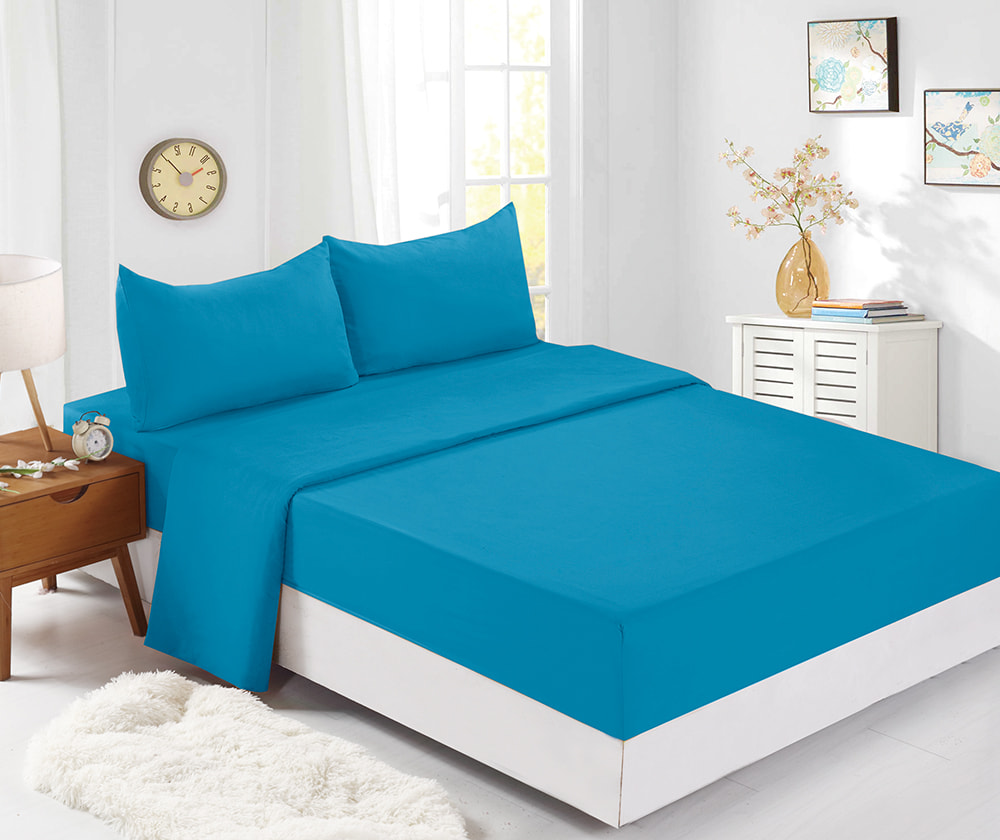
Solid Color Bed Sheet Set (4 Pieces)
Product Overview and Core Design
The solid-color bed sheet set uses a simple visual concept: coordinated bedding in one color, with a smooth and uncluttered appearance. This design is commercially useful because it can fit many interior styles. Neutral colors can support hotel rooms, student accommodation, serviced apartments, and rental housing, while stronger colors can appeal to fashion-conscious consumers seeking a quick bedroom refresh.
The product information identifies the article as a four-piece set. The supplied description refers to a fitted sheet, a duvet cover or bed sheet component, and pillowcases. The size chart lists bed sheet dimensions, fitted sheet dimensions, and pillowcase dimensions. Because piece quantities vary by size, buyers should confirm the final packing list and naming convention before placing a production order, particularly for the Twin configuration. This confirmation helps ensure that labels, online listings, cartons, and customer expectations all match the final shipment.
The set is made from 100% polyester. More specifically, the product description emphasizes microfiber polyester, a fine-fiber construction known for its soft surface and smooth touch. Compared with coarser woven fabrics, microfiber can provide a more comfortable next-to-skin experience while remaining practical for frequent washing and commercial use.
The design is intended for year-round use. The fabric’s fine fiber structure supports moisture-wicking and breathable performance, helping the bedding feel comfortable in different seasons. It is not positioned as a heavily insulated winter product; instead, it functions as a flexible bedding layer that can be used with different quilts, comforters, blankets, or duvets depending on the climate.
Key Product Advantages
The main advantages of this bedding set can be summarized in five areas: comfort, easy care, visual versatility, size variety, and supply flexibility.
First, the microfiber surface is soft and smooth. This is important because bedding remains in direct contact with the skin for many hours. A pleasant hand feel can improve perceived product value, even when the product is placed in an affordable or mid-market category.
Second, the polyester construction is durable and resistant to common household challenges. The supplied product description states that the fabric is wrinkle-resistant and designed to resist shrinkage and fading with everyday use. These characteristics can reduce the time required for ironing, handling, and replacement.
Third, solid colors are easy to merchandise. Retailers can group the product by color, size, collection, or bedroom theme. Solid-color bedding also photographs clearly for e-commerce listings because the product’s shape and surface are easy to see without a busy print competing for attention.
Fourth, the product is available in Twin, Full, Queen, and King sizes. This range enables one collection to serve multiple mattress markets. It also allows retailers to build a coordinated size assortment rather than relying on one standard dimension.
Fifth, the stated minimum order quantity is 50 sets per color and size. This level may be suitable for wholesalers, regional distributors, hospitality buyers, and private-label sellers that need a meaningful volume but do not want to begin with extremely large quantities for every variation.
Microfiber Polyester and Everyday Comfort
Material selection is one of the most important factors in bedding performance. The use of 100% microfiber polyester gives this set several characteristics that are relevant to both consumers and professional buyers.
Softness and Surface Smoothness
Microfiber is produced from very fine synthetic fibers. When processed into bedding fabric, these fibers can create a smooth surface with a soft touch. The result is a fabric that feels comfortable against the skin and can provide a more refined experience than basic, rough-textured polyester materials.
Softness also affects the first impression a customer receives when opening the package. In physical retail, buyers may touch a sample or display model. In online retail, the written description, product photographs, customer reviews, and packaging must communicate the same benefits. A soft microfiber construction gives sellers a clear performance feature to highlight without relying only on color or styling.
Breathability and Moisture Management
The product description emphasizes breathable and moisture-wicking properties. Bedding that allows air movement can help reduce the uncomfortable feeling associated with heat accumulation during sleep. Moisture management is also useful in warm climates, transitional seasons, guest rooms, and rooms with variable occupancy.
Breathability depends on more than fiber type. Fabric weight, weave, finishing, room temperature, humidity, mattress construction, and the use of blankets or quilts all influence the final sleeping experience. Nevertheless, a fine microfiber structure provides a practical foundation for a lightweight and comfortable bedding product.
Durability for Repeated Use
Unlike bedding intended only for occasional decorative use, sheets must withstand repeated laundering and regular handling. Polyester fibers are valued in many home textile applications because they can maintain their form and resist some of the dimensional changes associated with repeated washing. The product is described as resistant to shrinkage and fading, making it suitable for everyday household use and potential commercial applications.
For hospitality and institutional buyers, durability can influence the total cost of ownership. A product that maintains an acceptable appearance after repeated use may reduce replacement frequency and support more consistent room presentation. Proper washing practices remain essential, but a durable base material gives the buyer a stronger starting point.
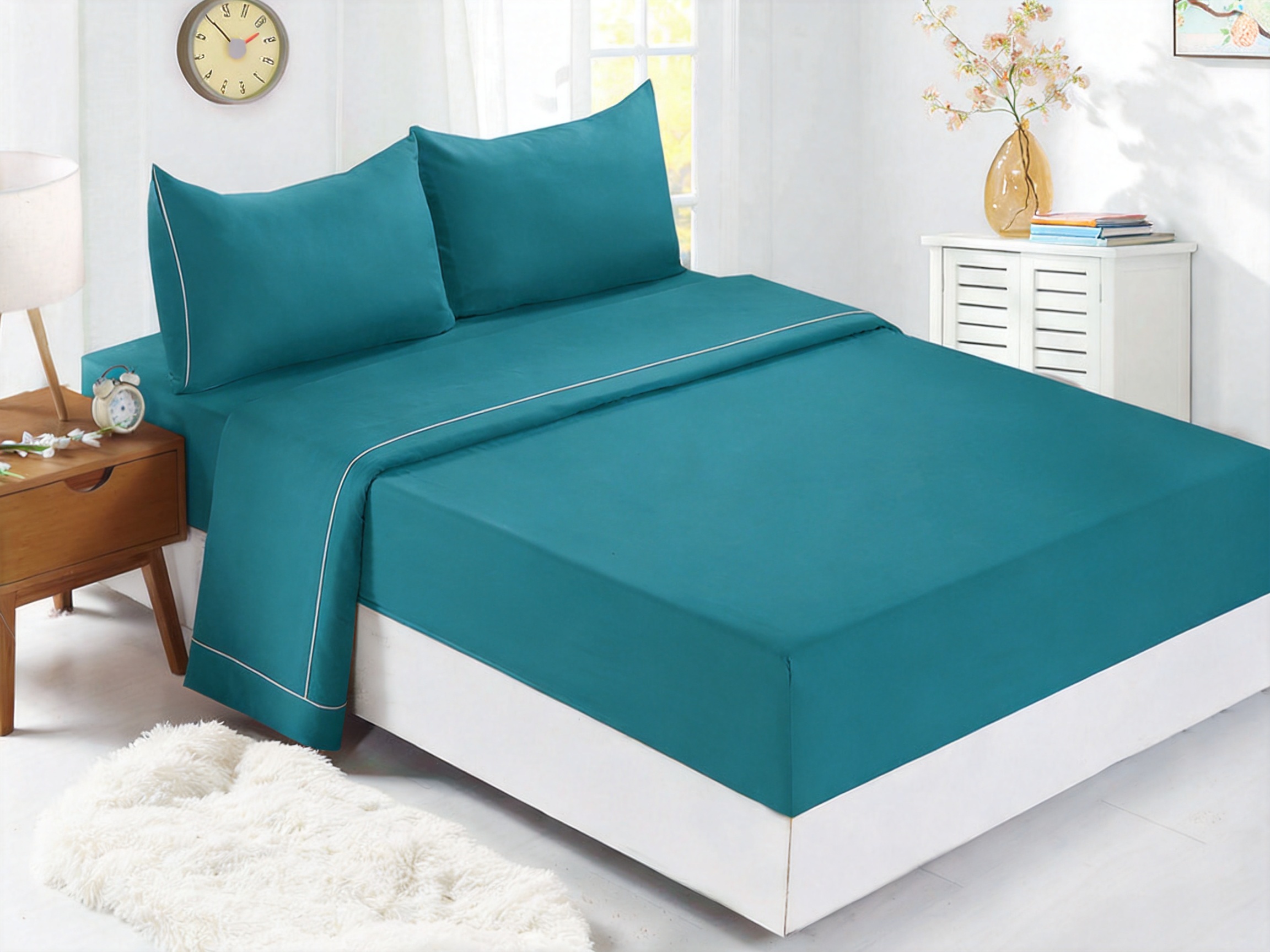
Size Range and Supplied Dimensions
The set is available in four principal size categories: Twin, Full, Queen, and King. The following table organizes the supplied dimensions into a clearer purchasing reference. Dimensions are presented as provided and should be checked against the buyer’s target mattress standards before bulk production.
| Size | Bed Sheet or Flat Sheet | Fitted Sheet | Pillowcase | Stated Minimum Order |
|---|---|---|---|---|
| Twin | 152 × 220 cm, 1 piece | 100 × 190 + 19 cm, 1 piece | 50 × 70 cm, 1 piece | 50 sets per color and size |
| Full | 200 × 225 cm, 1 piece | 140 × 190 + 19 cm, 1 piece | 50 × 70 cm, 2 pieces | 50 sets per color and size |
| Queen | 225 × 250 cm, 1 piece | 160 × 200 + 25 cm, 1 piece | 50 × 70 cm, 2 pieces | 50 sets per color and size |
| King | 250 × 270 cm, 1 piece | 200 × 200 + 25 cm, 1 piece | 50 × 100 cm, 2 pieces | 50 sets per color and size |
The notation “+19 cm” and “+25 cm” indicates additional depth or side allowance associated with the fitted sheet. Buyers should confirm whether this measurement represents mattress pocket depth, elastic allowance, or the complete side construction according to the factory’s production pattern. This is particularly important because mattress thickness differs between regions and product categories.
Dimension verification should be completed before order approval. A professional buyer may provide a mattress sample, technical drawing, target tolerance, or existing reference sample. The factory can then review the pattern, elastic placement, seam allowance, and finished measurement. This process helps prevent issues caused by differences between international bedding standards.
Why Multiple Sizes Matter to Retailers
A four-size range allows sellers to create a more complete assortment. Twin products can serve single beds, children’s rooms, dormitories, and compact apartments. Full sizes can appeal to smaller double beds and guest rooms. Queen sizes are commonly positioned as a mainstream household option, while King products address larger bedrooms and premium bedding displays.
Offering multiple sizes also improves cross-selling opportunities. Customers who purchase a bed sheet set may later need a matching quilt, duvet cover, waterproof fitted sheet, curtain, pillowcase, or cushion. A manufacturer with several related product categories can help buyers develop a broader home textile collection.
Solid Colors as a Commercial Advantage
Patterned bedding can create visual impact, but it can also limit the product’s target audience. A strong floral design, seasonal print, or highly specific motif may appeal to one group while being unsuitable for another. Solid colors provide a more adaptable alternative.
Coordination with Interior Styles
Solid bedding can be combined with patterned curtains, textured throws, decorative cushions, or printed quilts. It can also be layered with contrasting colors to create a contemporary appearance. This flexibility makes the product suitable for minimalist, Scandinavian-inspired, modern, classic, industrial, and hospitality interiors.
For professional buyers, the absence of complex patterns may simplify collection planning. A single fabric base can be offered in several colors, allowing the range to grow without requiring a completely new visual concept. This can support more efficient photography, labeling, marketing, and inventory management.
Lower Design Risk
Color preferences still vary between markets, but solid colors generally have a longer commercial life than highly seasonal patterns. A neutral tone can remain relevant across multiple selling periods. Retailers can also adjust their color assortment according to regional demand without changing the fundamental product structure.
Solid colors may also reduce the visual impact of minor pattern alignment issues that can occur in printed products. While color consistency remains important, a plain fabric does not require repeat matching or motif placement across seams. This can support a more streamlined production process.
Private-Label Potential
The simple design is well suited to private-label programs. Buyers can select approved colors, add woven labels, develop retail packaging, and position the product under a brand-specific collection. The product’s basic appearance can be adapted to different market segments, from value-oriented household goods to coordinated boutique bedding ranges.
Construction Features and Quality Considerations
Material quality is only one part of bedding performance. Construction details influence fit, appearance, durability, and customer satisfaction. Buyers evaluating this product should review the following areas during sample approval and pre-production inspection.
Fitted Sheet Dimensions
A fitted sheet should be designed to cover the mattress securely while maintaining a neat appearance. The pocket depth must correspond to the target mattress thickness. If the pocket is too shallow, the corners may pull away during use. If it is excessively deep, the fabric may gather or become loose.
The supplied specifications identify fitted sheet measurements with additional depth values of 19 cm or 25 cm. These options indicate that the product is intended to accommodate different mattress profiles. Buyers should verify the finished pocket depth, elastic quality, elastic coverage, and corner construction.
Seams and Hemming
Even stitching, clean hems, and secure seam finishes contribute to long-term usability. Bedding is repeatedly pulled, folded, washed, and dried, so weak or inconsistent seams can lead to premature damage. A factory with standardized production procedures can monitor stitch density, seam allowance, thread trimming, and edge finishing more effectively than a purely informal workshop.
Color Consistency
Color consistency is especially important for a solid-color collection. The color of the fitted sheet, flat sheet, and pillowcases should be visually coordinated. For repeat orders, the production team should maintain approved color standards and compare bulk fabric against retained samples or agreed references.
Lighting conditions can affect visual evaluation. Buyers and manufacturers should use consistent inspection lighting when reviewing shade differences. Clear color approval procedures can reduce disagreements between sample development and mass production.
Packaging and Folding
Packaging influences protection during transport and the product’s retail presentation. The final package should protect the fabric from dust, moisture, crushing, and handling damage. Labels should clearly identify the size, color, fiber composition, care instructions, and piece count.
Because the product is marketed as a four-piece set, piece-count information deserves particular attention. The buyer and factory should agree on the exact contents of every size variation. This is essential when the number of pillowcases differs between Twin and larger sizes or when the terminology distinguishes between a bed sheet, fitted sheet, duvet cover, or quilt cover.
Advantages Compared with Common Bedding Alternatives
The solid-color microfiber set competes with several types of bedding, including basic woven polyester, cotton sheets, printed bedding, and lower-cost blended fabrics. Each alternative has its own advantages, but the product described here offers a balanced combination of comfort, appearance, and practical care.
Compared with Basic Polyester Sheets
Basic polyester sheets can be economical, but they may feel less refined if the yarn or finishing quality is limited. Microfiber construction uses finer fibers to create a smoother surface. This can improve tactile appeal and make the product feel more comfortable without requiring a premium natural-fiber price.
Compared with High-Maintenance Natural Fibers
Cotton is widely appreciated for its natural hand feel and moisture absorption. However, some cotton products may wrinkle more easily, shrink during washing, or require more careful handling depending on the weave and finishing. Polyester microfiber offers a different performance balance, emphasizing smoothness, dimensional stability, wrinkle resistance, and ease of care.
The choice between microfiber polyester and cotton depends on the target market. For buyers seeking an affordable, easy-care, quick-turnover product, microfiber can be an effective option. For premium natural-fiber collections, cotton or blended fabrics may be selected instead. The value of this set lies in its practical positioning rather than an attempt to replace every bedding category.
Compared with Highly Printed Bedding
Printed products can create strong shelf appeal, but they may have shorter trend cycles and more complicated production requirements. Solid colors are easier to coordinate and can remain commercially relevant for longer periods. They are also suitable for buyers who want a calm, hotel-inspired or minimalist appearance.
Compared with Single-Size Programs
Some suppliers focus on only one or two standard sizes. The availability of Twin, Full, Queen, and King dimensions gives this product broader market coverage. Buyers can develop a complete assortment while working with one product platform and one manufacturing partner.
Manufacturing Capabilities and Integrated Production Strengths
The manufacturer behind this bedding set operates as an industrial and trade enterprise integrating research and development, production, sales, and export. This structure is valuable because bedding orders often involve more than fabric cutting and sewing. Buyers may require product selection, sample adjustment, color development, packaging coordination, quality inspection, documentation, and export support.
The company was founded in 2015 and operates a factory covering more than 10,000 square meters. Its workforce includes more than 100 employees, supported by intelligent production equipment, standardized management procedures, and an experienced foreign trade service team. These resources provide a foundation for handling both regular product programs and customized home textile orders.
Research and Development Support
Research and development enables a manufacturer to respond to changes in consumer preferences, mattress dimensions, fabric requirements, and packaging expectations. In the case of this bedding set, development work may involve fabric selection, color approval, fitted sheet patterns, size grading, sewing details, and packaging formats.
Customization based on customer samples is also available. A buyer may provide an existing product for reference, a technical specification, or a sample from a competing collection. The manufacturer can review the sample and discuss the required material, dimensions, construction, label placement, and packaging requirements.
Intelligent Production Equipment
Intelligent production equipment can improve production consistency and process efficiency. Automated or semi-automated systems may support cutting accuracy, fabric handling, sewing productivity, inspection, or packing operations. Equipment alone does not guarantee quality, but it can reduce avoidable variation when combined with trained operators and documented procedures.
For large or repeat orders, process standardization is especially important. A factory must be able to reproduce the approved sample across multiple colors, sizes, and production batches. Modern equipment and controlled workflows can help maintain more stable results.
Standardized Management
Standardized management supports communication between departments. Product development, purchasing, cutting, sewing, inspection, packaging, warehousing, and export personnel must work from the same approved information. Clear records for fabric composition, color references, dimensions, tolerances, packing quantities, and labeling requirements help prevent misunderstandings.
A standardized management system is also useful when customers request corrective action or repeat production. The factory can trace relevant production details, review inspection records, and make adjustments based on documented findings rather than relying only on memory.
Export and Foreign Trade Experience
All products are exported, and the company maintains an experienced foreign trade service team. Export experience can simplify communication regarding product specifications, commercial documents, packing marks, shipment coordination, and customer service. International buyers often need timely responses across different time zones and clear confirmation of technical details.
A supplier with both factory and export capabilities can provide more direct coordination. This may reduce the communication gap that can occur when product development, manufacturing, and international sales are handled by unrelated organizations.
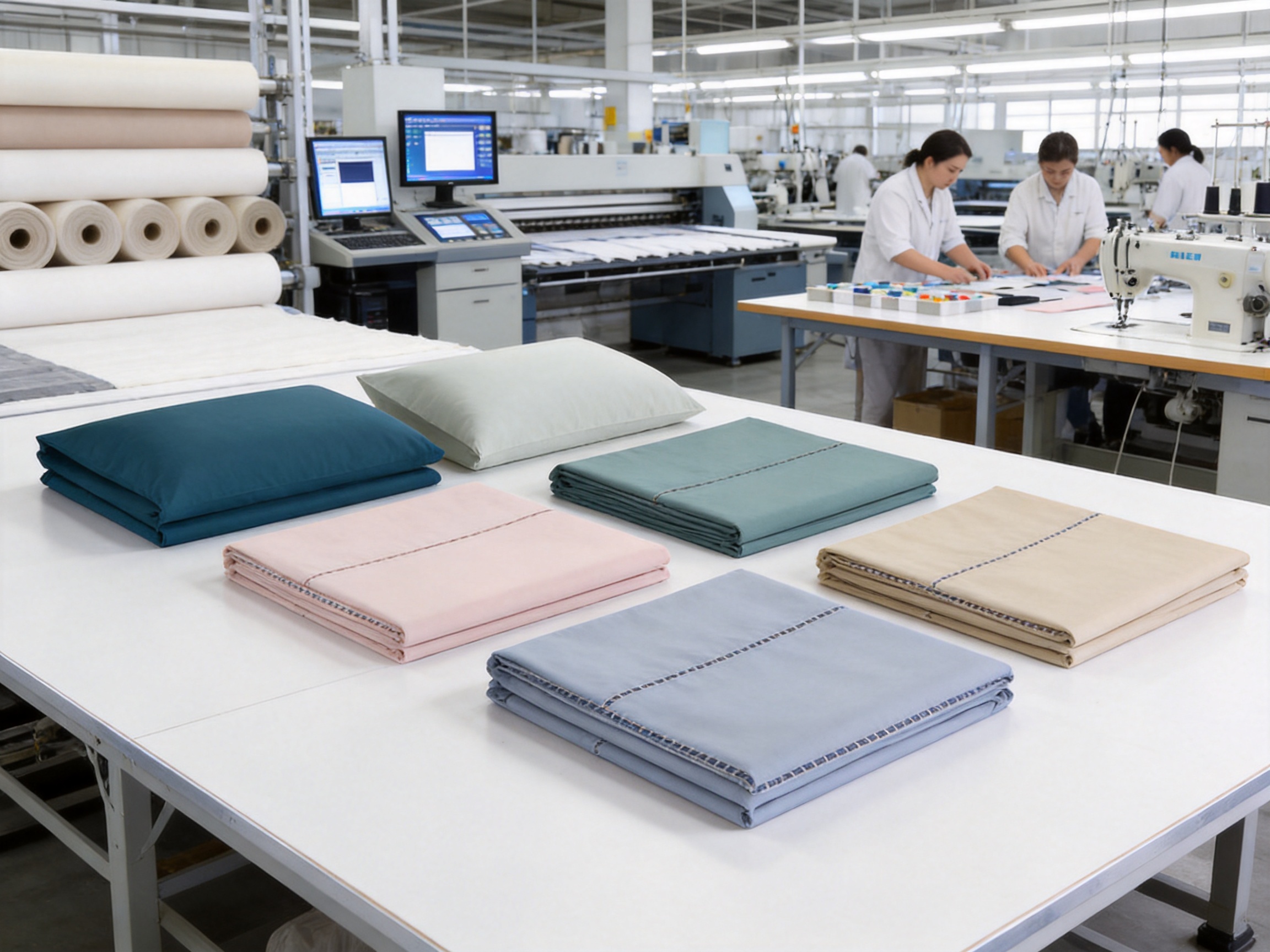
Quality Control for Bulk Orders
Quality control should begin before mass production. A strong purchasing process typically includes specification confirmation, sample approval, raw material review, production monitoring, finished product inspection, and packing verification.
Pre-Production Approval
Before bulk manufacturing begins, the buyer should approve a complete reference sample. This sample should represent the final fabric, color, size, sewing construction, labels, packaging, and piece count. If different sizes use different pillowcase quantities or fitted sheet depths, each relevant variation should be documented.
The approved sample becomes a practical reference for factory production and buyer inspection. Written specifications remain essential, but a physical sample can clarify details that are difficult to describe in words.
Fabric Inspection
Fabric inspection may include checks for color consistency, surface defects, holes, stains, weaving irregularities, width, weight, and hand feel. For solid-color microfiber bedding, shade consistency is particularly important. The inspection method and acceptance standard should be agreed upon according to the buyer’s quality requirements.
Cutting and Sewing Inspection
During production, inspectors can review cut-panel accuracy, seam alignment, edge finishing, elastic insertion, thread trimming, and component matching. Early inspection is preferable to discovering a systemic problem after the entire order has been completed.
Fitted sheets should be reviewed for correct corner construction and depth. Pillowcases should be checked for opening direction, finished dimensions, and clean hemming. Flat sheets or duvet-related components should be checked for size, shape, and any required closure or finishing details.
Finished Product Inspection
Final inspection can cover appearance, measurement, stitching, stains, holes, color, packaging, and quantity. AQL-based inspection may be used when agreed by the buyer and supplier. Regardless of the specific inspection system, the criteria should be defined before production so that both parties understand the expected result.
Packing Verification
Incorrect packing can create commercial problems even when the sewing quality is acceptable. The inspection team should verify the number of pieces per set, size labels, color labels, barcode information, carton quantities, and shipping marks. Random cartons may be opened to confirm that the internal contents match the external labeling.
Customization and OEM Development
The manufacturer provides customized home textile services based on customer samples. This creates opportunities for buyers that want to develop a distinct bedding program rather than purchase an unchanged standard item.
Possible Customization Areas
Depending on project requirements, customization may include fabric selection, color matching, dimensions, mattress pocket depth, pillowcase size, labels, packaging, folding method, insert cards, and carton markings. Buyers should discuss which elements are included in the quoted price and which may require additional development charges or minimum quantities.
Custom colors can help retailers build a brand identity or coordinate the bedding with existing curtains and home accessories. Custom dimensions can support regional mattress standards or special applications such as serviced apartments, dormitories, medical accommodation, and hospitality projects.
Sample-Based Development Process
A practical sample-development process begins with the buyer’s reference. The factory reviews the sample and identifies its material, structure, measurements, and finishing details. If the buyer’s sample is unavailable, a technical drawing and written specification can be used instead.
The manufacturer then develops a preliminary sample for review. The buyer checks the touch, color, dimensions, construction, and packaging. Corrections are recorded and incorporated into a revised sample when necessary. Once the sample is approved, the final specifications are documented for bulk production.
Communication for Successful Custom Orders
Successful customization depends on precise communication. Buyers should provide the intended market, mattress dimensions, fabric preference, color references, target price, expected annual volume, packaging requirements, and compliance needs. The factory should respond with realistic information about production feasibility, minimum quantities, lead times, and available materials.
It is also useful to distinguish between must-have requirements and optional preferences. For example, exact mattress pocket depth, fiber composition, and label information may be mandatory, while a particular folding style or decorative insert may be negotiable. This helps the development team prioritize technical accuracy and commercial value.
Suitability for Different Customer Groups
The bedding set can serve several types of buyers because of its broad size range, simple appearance, and practical fabric.
Retailers and Online Sellers
Retailers can present the set as an affordable, easy-care bedroom essential. Online sellers may emphasize softness, wrinkle resistance, year-round use, solid colors, and multiple sizes. Product photography can show the set on a made bed, close up the microfiber surface, and display the contents and dimensions clearly.
Wholesalers and Distributors
Wholesalers can purchase multiple colors and sizes to serve local home furnishing stores. The minimum order quantity of 50 sets per color and size may support a structured assortment without requiring an exceptionally large initial investment for each variation.
Hotels and Serviced Apartments
Hospitality properties often need coordinated bedding that can be laundered frequently and presented consistently. The smooth appearance, easy-care properties, and size options may make the product suitable for selected hotel, apartment, and guest-room programs. Hospitality buyers should conduct laundering and performance tests according to their own operational standards before placing a large order.
Property Managers and Rental Housing Providers
Rental housing, student accommodation, and serviced apartments may benefit from bedding that is practical, replaceable, and visually neutral. Solid colors can create a clean appearance across rooms with different furniture styles. The availability of replacement sets in the same product program can also simplify ongoing maintenance.
Private-Label Home Textile Brands
Private-label brands can use the product as a foundation for a coordinated bedding collection. Labels, packaging, selected colors, and size combinations can be adapted to the brand’s market position. The manufacturer’s broader product range may also support future expansion into quilts, curtains, cushions, mattress protectors, and other complementary categories.
Care, Handling, and Product Presentation
Correct care information helps protect customer satisfaction. The final care label should be confirmed with the manufacturer according to the fabric composition and finishing method. Buyers commonly review recommended washing temperature, drying instructions, ironing guidance, and restrictions on harsh chemicals.
Because the product is designed to be wrinkle-resistant and easy to care for, sellers can position it as convenient for busy households. However, care claims should remain accurate and should reflect tested performance. Avoiding excessive heat, following detergent recommendations, and separating strongly colored textiles can help maintain the bedding’s appearance.
Product presentation should explain the difference between the components. Customers should be able to understand whether the set contains a fitted sheet, a flat or bed sheet, a duvet cover, and pillowcases. Where the component list differs by size, this information should be displayed prominently rather than hidden in small print.
Commercial Positioning and Competitive Value
The strongest market position for this product is a balance between comfort, appearance, durability, and affordability. It is not dependent on elaborate decoration or costly natural fibers. Instead, it delivers practical features that matter in daily use.
Its competitive value comes from the combination of a soft microfiber surface, solid-color versatility, wrinkle resistance, resistance to shrinkage and fading, multiple mattress sizes, and the ability to support OEM development. Many competing products may offer one or two of these features, but a coordinated manufacturing program can make the complete package more valuable to professional buyers.
The company’s integrated factory and trade structure adds another competitive advantage. Buyers can work with a supplier that manages product development, manufacturing, export, and customization within one organization. The more than 10,000-square-meter factory, workforce of over 100 employees, intelligent equipment, standardized management, and foreign trade experience provide a platform for repeat orders and broader home textile cooperation.
For buyers comparing suppliers, the decision should not be based only on unit price. Other factors include sample accuracy, communication speed, quality consistency, minimum order quantity, packaging capability, production capacity, customization support, and after-sales responsiveness. A reliable supplier can create greater long-term value even when the lowest quoted price comes from another source.
Recommended Purchasing Process
A professional purchasing process can be organized into several steps.
First, define the target market and product position. Determine whether the bedding is intended for household retail, hospitality, private label, online sales, or contract supply.
Second, confirm the technical requirements. Specify the fiber composition, fabric type, colors, sizes, fitted sheet depth, pillowcase quantity, component names, labels, packaging, and carton information.
Third, request and review samples. Check softness, color, dimensions, stitching, fitted sheet fit, packaging, and the complete set contents.
Fourth, approve the final specifications in writing. Include tolerance requirements and the agreed inspection standard.
Fifth, confirm production and shipment details. Review the minimum order quantity, lead time, payment terms, packing method, shipping marks, and export documents.
Sixth, conduct quality inspections. Inspection may be performed during production and before shipment, depending on the order size and buyer’s quality program.
Finally, retain an approved sample and production records for future repeat orders. This helps maintain consistency when the buyer reorders the same color and size several months later.
Questions and Answers
What material is used for the bedding set?
The set is made from 100% polyester, with the product description specifying a microfiber polyester construction. The material is designed to provide a soft, smooth, breathable, durable, and easy-care surface.
Is the product suitable for year-round use?
Yes. The fine fiber structure is described as breathable and moisture-wicking, making the set suitable for use throughout the year. The final comfort level will also depend on room temperature, mattress type, blankets, quilts, and local climate.
What sizes are available?
The available sizes are Twin, Full, Queen, and King. Each size has its own bed sheet, fitted sheet, and pillowcase dimensions.
What does the additional measurement on the fitted sheet mean?
The supplied specifications list fitted sheet measurements such as 100 × 190 + 19 cm and 160 × 200 + 25 cm. These additional values relate to the fitted sheet’s depth or side allowance. Buyers should confirm the exact interpretation and finished pocket depth with the manufacturer before ordering.
How many pillowcases are included?
The supplied information lists one 50 × 70 cm pillowcase for Twin, two 50 × 70 cm pillowcases for Full and Queen, and two 50 × 100 cm pillowcases for King. Because the product is described as a four-piece set while the listed components vary, buyers should confirm the final packing list and product terminology for each size.
What is the minimum order quantity?
The stated minimum order quantity is 50 sets per color and size. Buyers should confirm whether different colors or sizes can be combined under special order conditions.
Can the product be customized?
Yes. Customized home textile services are provided based on customer samples. Potential customization areas may include colors, dimensions, construction, labels, packaging, and related product details, subject to development requirements and minimum quantities.
Is the bedding suitable for private-label sales?
Yes. The solid-color design and flexible OEM support make it suitable for private-label collections. Buyers can discuss brand labels, retail packaging, color programs, and product information with the manufacturer.
What should buyers check before bulk production?
Buyers should check the material, color, dimensions, fitted sheet depth, pillowcase quantity, component list, sewing quality, labels, packaging, care instructions, and inspection standard. A complete approved sample is recommended.
What types of companies can purchase this product?
Potential buyers include retailers, wholesalers, distributors, online sellers, hotels, serviced apartments, property managers, private-label brands, and contract furnishing companies.
Does the manufacturer produce other home textiles?
Yes. The company produces bed sheets, quilt covers, pillowcases, cushions, quilts, waterproof mattress protectors, curtains, and other bedding sets. This can support coordinated product sourcing from one supplier.
Why is solid-color bedding commercially useful?
Solid colors are easy to coordinate with other bedroom products and interior styles. They can appeal to minimalist, modern, classic, hospitality, rental, and family-home markets. They are also suitable for repeat collections and private-label programs.
Conclusion
The solid-color four-piece bed sheet set combines a soft microfiber polyester surface with practical everyday performance. Its smooth hand feel, breathable structure, wrinkle resistance, resistance to shrinkage and fading, and broad size range make it a versatile choice for household and commercial bedding programs.
The product’s simple solid-color design provides strong merchandising flexibility. Retailers can offer multiple shades, private-label sellers can build a coordinated collection, and hospitality buyers can create a clean and consistent room appearance. The available Twin, Full, Queen, and King sizes further expand its market potential.
Equally important is the manufacturing platform behind the product. Dongyangshi Menghui Textile Co., Ltd. integrates research and development, production, sales, and export. Its factory of more than 10,000 square meters, workforce of over 100 employees, intelligent equipment, standardized management system, and experienced foreign trade team support reliable OEM and export cooperation.
For the best purchasing result, buyers should confirm all technical details, especially the exact four-piece configuration, fitted sheet depth, pillowcase quantity, color standards, packaging, and quality requirements. With clear communication and sample approval, this bedding set can serve as a practical foundation for retail, hospitality, wholesale, and customized home textile programs.
References
1. Product specification and technical information supplied for the solid-color four-piece bed sheet set.
2. Manufacturer-provided company information concerning production facilities, product categories, export operations, and customized home textile services.
3. General textile manufacturing principles concerning microfiber polyester, fabric durability, bedding construction, quality inspection, and care requirements.
4. General home textile merchandising practices concerning solid-color bedding, size assortment planning, private-label development, and hospitality supply.
Product: Solid Color Bed Sheet Set (4 Pieces)


Contact Us for More Details
Don't hesitate to contact when you need us!
Contact Information
Add:
Building 1, East Area, Wanyang Zhongchuang City, Economic Development Zone, Dongyang City, Zhejiang Province, China
Phone:
Tel:
E-mail:
Quick Links
Product Category
QR Code


+86-13616899966
+86-579-86610966
