 English
 русский
 Español
 عربى


All-Season 22-Piece Bed Cover Set: A Complete Coordinated Solution for Modern Bedrooms
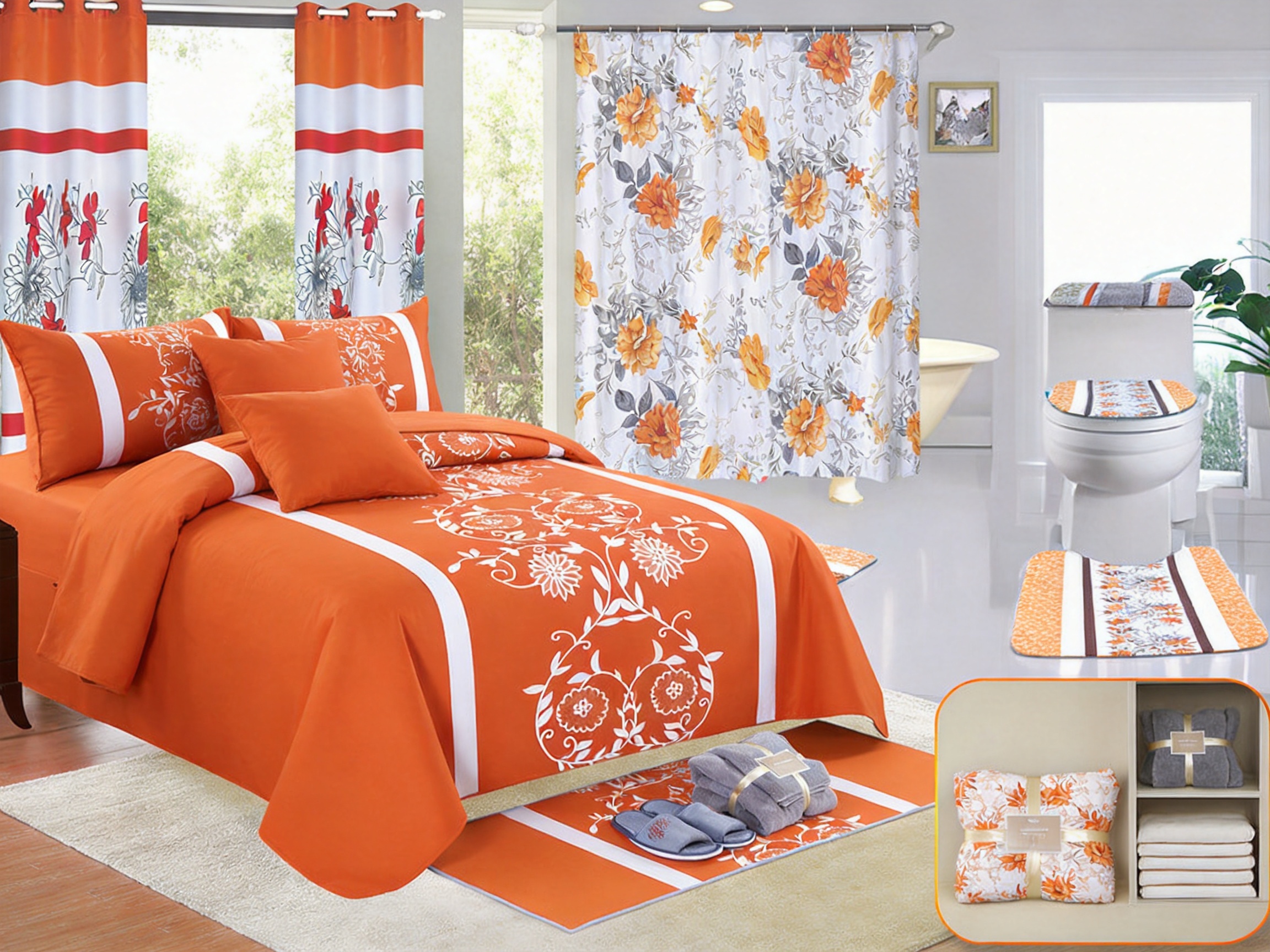
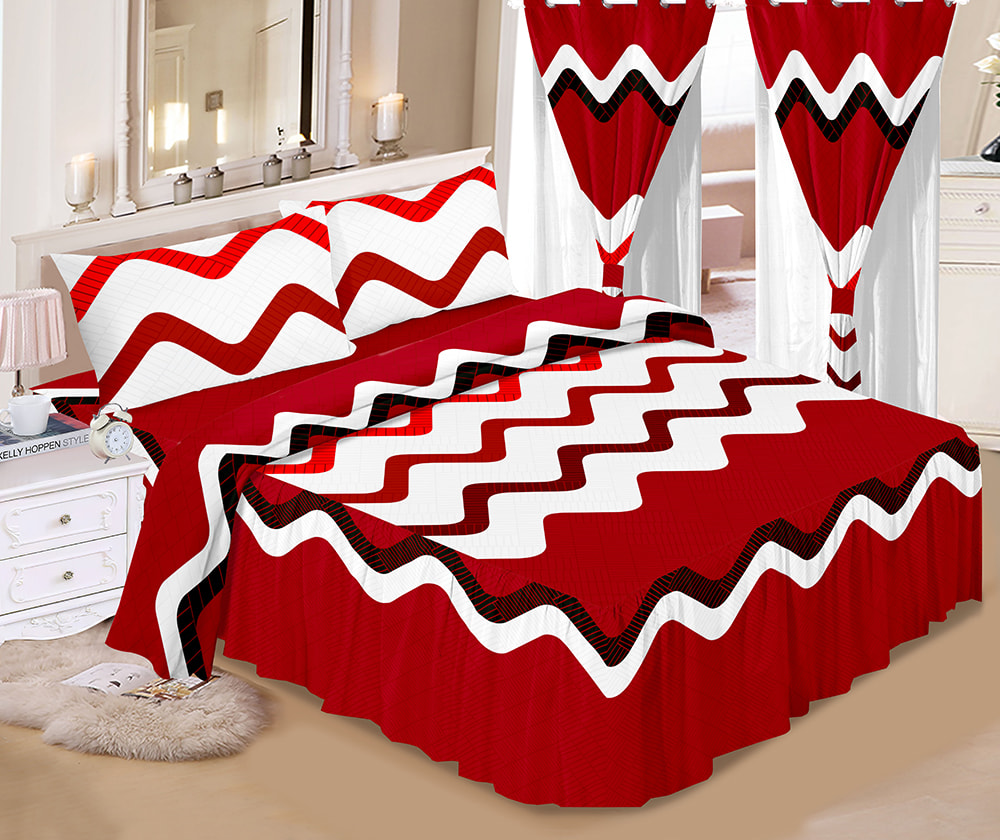
Choosing a bedding set is no longer limited to selecting a bedspread and a pair of pillowcases. Modern consumers increasingly look for coordinated home textile solutions that improve the visual harmony of the bedroom while also simplifying purchasing, installation, care, and replacement. The All-Season 22-Piece Bed Cover Set responds to this demand by combining essential bedding items with matching window, decorative, and bathroom textiles in one comprehensive package.
Designed for residential use, hospitality projects, furnishing programs, and wholesale distribution, this printed bedding collection brings together a bedspread, flat sheet, fitted sheet, pillowcases, curtains, cushion covers, a floor mat, toilet textiles, slippers, towels, and a shower curtain. The complete configuration is intended to create a consistent interior style rather than a collection of unrelated individual products.
The set is made from 100% polyester microfiber. This material offers a practical balance of softness, light weight, color presentation, easy care, and manufacturing efficiency. Compared with heavier or more demanding textile constructions, microfiber polyester is well suited to products that require frequent washing, repeat production, consistent sizing, and cost-conscious international distribution.
Manufactured by Dongyangshi Menghui Textile Co., Ltd., the collection benefits from an integrated production and export structure. The company combines product research and development, manufacturing, sales, and international trade. Its factory covers more than 10,000 square meters and employs more than 100 people, supported by intelligent production equipment, standardized management, and an experienced foreign trade service team.
This article examines the product in detail, including its configuration, material properties, size options, design advantages, manufacturing strengths, customization potential, care considerations, and suitability for different purchasing channels.
1. What Makes This Bedding Set Different?
The most important distinction is the breadth of the package. Many bedding products are sold as isolated categories: a quilt cover is purchased separately from a sheet set, curtains are selected from another collection, and bathroom accessories are matched later. This approach may provide flexibility, but it can also create challenges in color coordination, purchasing administration, inventory management, and room presentation.
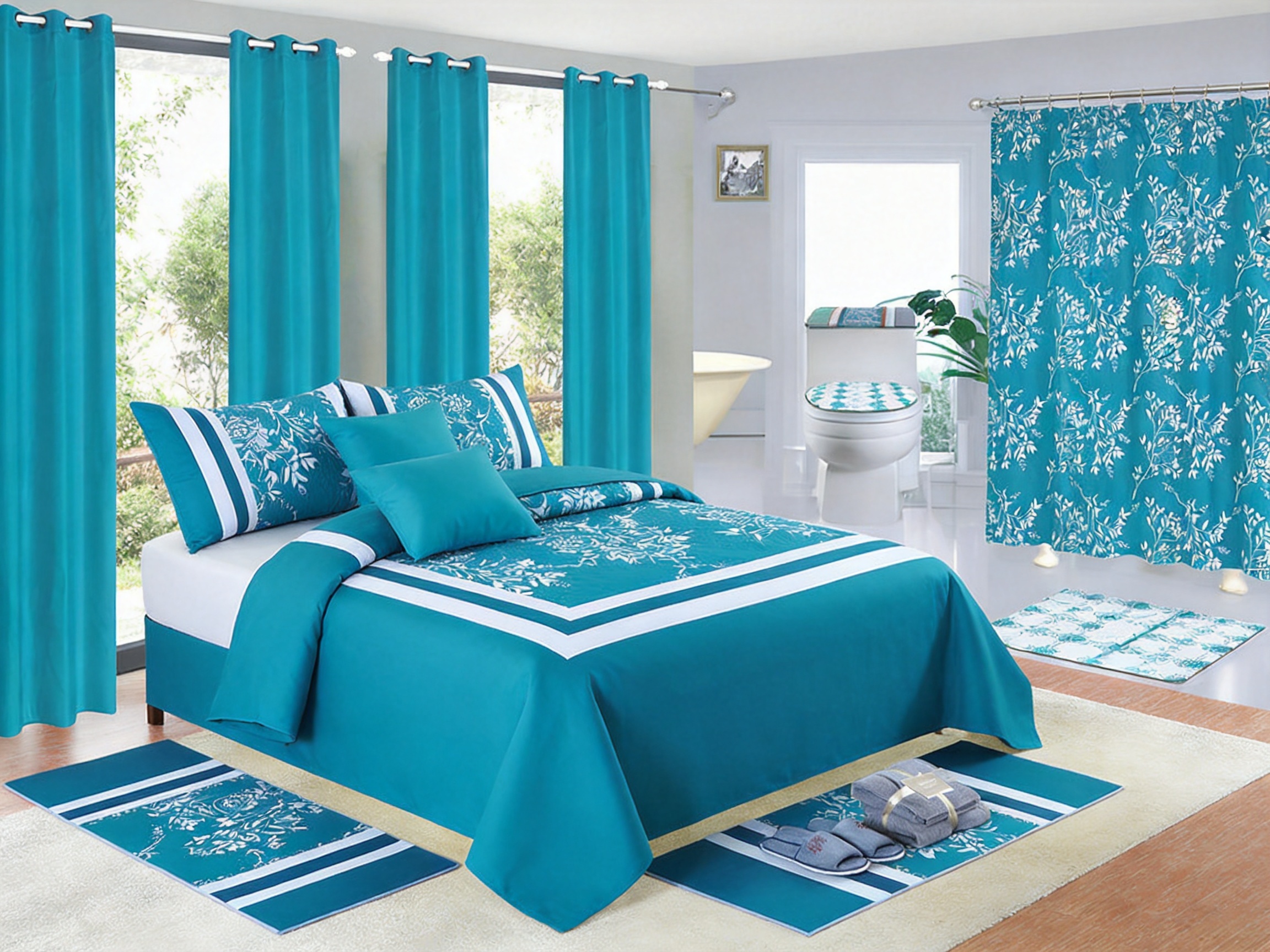
The 22-piece bed cover set takes a more complete approach. It is structured as a coordinated home textile package, allowing buyers to furnish several visual and functional zones at once. The bedroom receives its central bed covering, sheets, fitted sheet, and pillowcases. The windows receive matching curtains. Accent areas can be completed with cushion covers and a floor mat. The bathroom can be coordinated with a toilet textile set, towels, slippers, and a shower curtain.
This broader configuration offers several practical advantages:
• A single purchase can establish a unified room style.
• Buyers can reduce the time spent matching colors and patterns across suppliers.
• Retailers can offer a high-value package instead of several disconnected items.
• Hospitality buyers can simplify room preparation and textile sourcing.
• Wholesalers can market the collection as a complete furnishing solution.
• Homeowners can refresh a bedroom and related spaces without searching for numerous compatible products.
The printed design is another central feature. A coordinated print can visually connect large surfaces, such as the bedspread and curtains, with smaller elements, such as cushions and bathroom textiles. When the same or complementary print language is used throughout the room, the result can appear more intentional and professionally styled.
Rather than competing only on the basis of one individual textile, this product competes through completeness, convenience, coordinated presentation, and flexible supply support.
2. Product Overview and Intended Positioning
The product is identified as an All-Season 22-Piece Bed Cover Set and a Four Seasons Universal Bedding Set. It is also described as a printed color summer quilt set and a luxury sheet set. These descriptions indicate a versatile bedding collection intended for broad home use, seasonal styling, and coordinated presentation.
The term “all-season” should be understood in the context of a versatile bedding ensemble rather than as a guarantee that one quilt thickness will provide the same insulation in every climate. Actual thermal performance depends on the construction and filling weight of the bedspread or quilt, room temperature, local climate, and personal sleeping preferences. Buyers requiring a specific thermal rating should confirm the quilt construction, weight, and filling details before placing a production order.
The collection is especially suitable for customers who value visual completeness. A basic sheet set may meet sleeping needs, but it does not necessarily address windows, decorative seating, flooring, or bathroom coordination. This package extends beyond the bed itself and therefore has stronger potential as a room styling product.
For retail, the set can be positioned as a complete bedroom makeover package. For hospitality, it can be presented as a coordinated textile program for guest rooms, serviced apartments, holiday properties, or furnished rentals. For wholesalers, the large number of components creates opportunities for different sales formats, including full-set distribution, regional assortment planning, or selective bundling.
3. Detailed Configuration
The product information provides Queen Size and King Size configurations. The principal dimensions are shown below. Dimensions are supplied in centimeters and should be reviewed against the final production specification, packaging plan, and target-market bed standards.
| Configuration | Component | Quantity | Dimension |
|---|---|---|---|
| Queen Size | Bedspread | 1 piece | 223 × 228 cm |
| Queen Size | Bed sheet | 1 piece | 210 × 230 cm |
| Queen Size | Fitted sheet | 1 piece | 152 × 203 + 30 cm |
| Queen Size | Pillowcases | 2 pieces | 50 × 70 cm |
| Queen Size | Curtains | 6 pieces | 95 × 220 cm each |
| Queen Size | Cushion covers | 2 pieces | 45 × 45 cm |
| Queen Size | Floor mat | 1 piece | 50 × 150 cm |
| Queen Size | Toilet textile set | 1 set | 4-piece set |
| Queen Size | Slippers | 1 pair | Pair format |
| Queen Size | Towel set | 1 set | 2-piece set |
| Queen Size | Shower curtain | 1 piece | Size to be confirmed |
| King Size | Bedspread | 1 piece | 226 × 260 cm |
| King Size | Bed sheet | 1 piece | 235 × 270 cm |
| King Size | Fitted sheet | 1 piece | 198 × 203 + 30 cm |
| King Size | Pillowcases | 2 pieces | 50 × 100 cm |
| King Size | Curtains | 6 pieces | 95 × 220 cm each |
| King Size | Cushion covers | 2 pieces | 45 × 45 cm |
| King Size | Floor mat | 1 piece | Specification to be confirmed |
| King Size | Toilet textile set | 1 set | 4-piece set |
| King Size | Slippers | 1 pair | Pair format |
| King Size | Towel set | 1 set | 2-piece set |
| King Size | Shower curtain | 1 piece | Size to be confirmed |
The supplied product listing refers to the collection as a 22-piece set. Because some entries are presented as sets or pairs, buyers should confirm how the commercial piece count is calculated for packaging, labeling, customs documentation, and retail presentation. In particular, the toilet textile set, towel set, and slippers may be counted by set or by individual physical pieces depending on the sales market.
This clarification is not a weakness of the product. It is a normal specification issue for a multi-component home textile package. Accurate piece-count labeling helps prevent confusion between the number of listed product categories, the number of retail units, and the number of individual textile articles inside each set.
The Queen Size configuration is appropriate for buyers using a more compact bed platform and standard pillow dimensions. The King Size configuration provides a larger bedspread, sheet, and fitted sheet, as well as longer pillowcases. Buyers should compare these measurements with their own mattress depth, bed width, pillow dimensions, and curtain installation requirements.

All-Season 22-Piece Bed Cover Set
4. Material Advantages of 100% Microfiber Polyester
Material selection has a direct effect on comfort, appearance, durability, production consistency, and care requirements. This bedding set uses 100% polyester microfiber, a material widely used in modern bedding and household textiles.
4.1 Soft Hand Feel
Microfiber is formed from very fine synthetic fibers. When properly processed and finished, these fibers create a smooth and soft surface that feels comfortable against the skin. The hand feel is an important selling point for sheets, pillowcases, and bed coverings because consumers often evaluate bedding first through touch.
Compared with coarse or poorly finished polyester fabrics, a well-made microfiber textile can provide a more refined tactile experience. The exact softness depends on yarn specification, fabric construction, finishing treatment, weight, and production quality. For this reason, professional sample approval remains important before mass production.
4.2 Easy Care
Polyester microfiber is generally convenient for routine household use. It is commonly selected for products that require frequent washing and rapid turnaround. The material typically dries faster than many heavier natural-fiber constructions, helping households and professional users return the textiles to service quickly.
Easy-care performance is especially valuable for guest accommodations, furnished rentals, dormitories, and families with frequent laundry requirements. Proper washing temperatures, detergent selection, drying methods, and ironing instructions should still be confirmed for the final fabric and print.
4.3 Lightweight Construction
Microfiber polyester can produce a lightweight textile with good coverage. This supports easier handling during bed making, storage, shipping, and laundering. A lighter package may also reduce logistical burden compared with a similarly sized collection made from heavier materials.
For international wholesale buyers, product weight influences carton planning, freight calculations, warehouse handling, and delivery economics. The final weight should be confirmed from the approved sample because it can vary with fabric density, filling, quilting, accessories, and packaging.
4.4 Print Presentation
The printed design is intended to give the collection a harmonious overall style. Polyester fibers can be suitable for colorful printed home textiles because they support clear pattern reproduction when the fabric, dyeing or printing process, and finishing system are properly matched.
Pattern consistency is particularly important for a coordinated package. The bedspread is the largest visual surface, while curtains, cushions, and bathroom accessories provide supporting areas. If color balance and print scale are controlled carefully, the set can create a stronger decorative effect than unrelated items sourced separately.
4.5 Dimensional Practicality
Polyester fabrics are commonly valued for their relatively stable dimensions when manufactured and finished correctly. Dimensional stability helps sheets fit mattresses more predictably and helps curtains and cushion covers retain their intended proportions. However, all textile products can be affected by washing, heat, mechanical stress, and improper care. Buyers should rely on tested production specifications rather than general material assumptions.
5. Coordinated Design Across the Home
The collection is not limited to one bed covering. Its design concept extends across the bedroom and bathroom, creating a complete interior story. This is one of the clearest advantages over conventional bedding packages that contain only a bedspread, sheet, and pillowcases.
5.1 The Bed as the Main Visual Focus
The bedspread serves as the central visual anchor. Its relatively large surface area makes it the first element noticed when entering a bedroom. A printed bedspread can conceal the underlying bedding and create an immediate sense of order, color, and style.
The matching flat sheet and fitted sheet support practical sleeping use. The fitted sheet is designed with an added depth specification of 30 centimeters, shown as “152 × 203 + 30 cm” for Queen Size and “198 × 203 + 30 cm” for King Size. The additional depth is intended to accommodate mattress thickness, although the buyer should compare it with the actual mattress profile and any mattress topper used.
5.2 Pillowcases and Cushion Covers
Pillowcases complete the sleeping area and help maintain the visual relationship between the bedspread and the pillows. The separate cushion covers add a decorative layer. At 45 × 45 centimeters, they are suitable for square accent cushions and can be used to create a more styled appearance on the bed, a bench, or a nearby chair.
Decorative cushion covers also provide flexibility. A consumer may use the covers seasonally, remove them for a simpler appearance, or combine them with plain cushions. Retailers can present these covers as value-added accessories that make the set appear more complete without significantly increasing installation complexity.
5.3 Curtains and Window Coordination
The inclusion of six curtain pieces provides an opportunity to coordinate windows with the bed. Each listed curtain measures 95 × 220 centimeters. Before installation, buyers should confirm whether this measurement refers to each finished panel, whether a heading or hanging tape is included, and whether the number of panels is appropriate for the target window width.
Window treatment requirements vary substantially by market. Some customers prefer gathered curtains, while others need a more streamlined drop. Curtain fullness, rod width, header construction, lining, and hanging method all influence final appearance. The listed dimensions provide a useful starting specification, but installation conditions should be confirmed for each project.
5.4 Floor and Bathroom Accessories
The 50 × 150 centimeter floor mat extends the coordinated design toward the floor area. The toilet textile set, towels, slippers, and shower curtain continue the visual theme into the bathroom. This creates a stronger opportunity for complete room merchandising and can be especially attractive for furnished accommodation providers.
Bathroom textiles often experience more frequent moisture exposure and washing than decorative bedroom items. Buyers should therefore confirm absorbency, backing construction, colorfastness, drying instructions, and the intended use of each accessory. The product information establishes the inclusion of these categories, while detailed technical specifications should be agreed during order confirmation.
6. Advantages Over Conventional Bedding Sets
Product comparisons should be based on actual purchasing needs rather than broad claims. In practical terms, this collection offers several advantages over a conventional bedding set containing only a bedspread, sheet, fitted sheet, and pillowcases.
6.1 Broader Coverage
A standard bedding set addresses the bed. This collection addresses the bed, windows, decorative cushions, floor area, and bathroom. The broader coverage can create greater perceived value for consumers and more opportunities for retailers to communicate benefits beyond basic sleeping comfort.
6.2 Simpler Coordination
Matching multiple home textile categories can be difficult when products are sourced from different suppliers. Color tone, print scale, fabric texture, and shrinkage behavior may vary. A coordinated set reduces the number of matching decisions and gives the buyer a unified starting point.
6.3 More Efficient Purchasing
For project buyers, managing one coordinated product specification can be more efficient than placing separate orders for bed linens, curtains, cushions, mats, and bathroom textiles. Fewer supplier relationships can simplify communication, sampling, packaging review, production tracking, and quality documentation.
6.4 Stronger Merchandising Potential
The set can be displayed as a lifestyle solution rather than as a single textile. Retailers may use room photography, bundled promotions, seasonal collections, or complete-room campaigns. The many components give sales teams more ways to explain value and encourage customers to consider a broader purchase.
6.5 Flexible Use Across Customer Segments
The product can serve household consumers, wholesalers, furnishing contractors, hospitality buyers, and distributors. A conventional bedding set may be appropriate for one segment, while this larger collection can be adapted to different sales channels through packaging, assortment, and customization options.
These advantages do not eliminate the need to compare fabric weight, stitching, colorfastness, packaging, and compliance requirements. Instead, they demonstrate how the product creates value through integration as well as through individual textile performance.
7. Manufacturing Capabilities Behind the Product
The product is supported by an industrial and trade enterprise that integrates research and development, production, sales, and export. This structure is significant for buyers seeking more than a one-time trading transaction. An integrated supplier can participate in product development, sample review, production planning, export preparation, and after-sales communication within one organization.
The company was founded in 2015 and focuses on bedding and related home textile categories. Its product range includes bed sheets, quilt covers, pillowcases, cushions, quilts, waterproof mattress protectors, curtains, and other bedding sets. This category experience is relevant to the 22-piece collection because the product combines several of these textile forms in one coordinated program.
7.1 Factory Scale
The factory covers more than 10,000 square meters and has more than 100 employees. A facility of this scale can support organized movement from fabric preparation and cutting to sewing, inspection, finishing, packing, and dispatch. Scale alone does not guarantee quality, but it provides a foundation for production planning and capacity management.
For buyers, factory scale can also support larger wholesale orders and repeat programs. Consistent repeat production depends on fabric availability, approved samples, documented specifications, trained personnel, and effective quality control. These systems are particularly important when a product includes many components that must remain visually coordinated.
7.2 Intelligent Production Equipment
The company operates intelligent production equipment. In home textile manufacturing, equipment modernization can improve repeatability in cutting, sewing, quilting, embroidery, inspection, or packaging processes, depending on the specific machinery deployed.
Automation and intelligent equipment can help control dimensions, reduce avoidable handling errors, improve production rhythm, and support more consistent output. These benefits are especially useful for products involving multiple sizes and repeated component sets. A fitted sheet, curtain panel, cushion cover, and pillowcase each have different construction requirements, so process organization is essential.
7.3 Standardized Management
Standardized management helps convert an approved product concept into a repeatable production specification. For a multi-piece bedding set, the specification should cover fabric composition, fabric weight, color references, print placement, measurements, seam allowances, elastic requirements, quilting details, accessory construction, labels, folding, and packaging.
Standardization also supports communication between sales, development, production, inspection, and export teams. When a customer orders the same design again, documented specifications reduce reliance on memory and help protect consistency between batches.
7.4 Foreign Trade Experience
The company has an experienced foreign trade service team and exports its products. International orders require attention to more than production. They may involve product naming, commercial invoices, packing lists, carton marks, shipping schedules, customs descriptions, destination-market requirements, and communication across time zones.
A supplier familiar with export procedures can help buyers clarify specifications before production begins. This is valuable for a 22-piece collection because the shipment contains different categories that may need clear packing and labeling. The buyer should still provide destination-specific instructions and verify all regulatory obligations independently.
8. OEM and Custom Home Textile Support
The company provides OEM home textile customization services and can develop products based on customer samples. This capability is important for buyers who do not want to sell a generic printed set or who need a collection aligned with a specific retail identity, hotel concept, interior design scheme, or regional market preference.
8.1 Sample-Based Development
Sample-based development allows a buyer to communicate requirements through a physical reference. The sample may demonstrate fabric hand feel, print appearance, dimensions, finishing, stitching, color relationships, or packaging expectations. The supplier can then evaluate how to translate the reference into a production-ready specification.
A sample should not be treated as an informal suggestion. It should be accompanied by written details wherever possible. Buyers should identify which features are mandatory, which may be adjusted for production, and which must be confirmed through a pre-production sample.
8.2 Design Adaptation
Customization may involve print design, color combinations, fabric selection, component quantities, size options, labels, packaging, and market-specific presentation. For example, a buyer may request a neutral palette for minimalist interiors, a more colorful print for seasonal retail, or a private-label package for a hotel furnishing program.
Because the product includes many components, design adaptation should consider the full set rather than only the bedspread. A print that looks attractive on a large bed surface may need adjustment for a narrow curtain panel, a 45 × 45 centimeter cushion cover, or a small bathroom accessory. Scale, repeat, seam placement, and color balance should be reviewed across all articles.
8.3 Private-Label Opportunities
OEM projects may include custom labels, hangtags, care instructions, cartons, polybags, or other packaging elements. These details can help a retailer or distributor present the collection as part of its own assortment. Packaging requirements should be finalized early because they can influence material purchasing, production scheduling, carton dimensions, and shipping calculations.
8.4 Development and Approval Process
A responsible customization process normally includes the following stages:
1. Requirement collection, including target market, dimensions, fabric, print, quantity, packaging, and compliance needs.
2. Design review and feasibility assessment.
3. Material and color confirmation.
4. Prototype or pre-production sample development.
5. Measurement, workmanship, and appearance approval.
6. Finalization of labels, packing, and shipping marks.
7. Bulk production according to the approved specification.
8. In-process and final inspection.
9. Packing, documentation, and export shipment.
The exact process may vary according to order size and product complexity, but this structured approach reduces the risk of misunderstandings.
9. Quality Considerations for a Multi-Component Set
Quality assessment for a coordinated bedding package must cover more than fabric softness. Every component affects the customer’s experience and the credibility of the overall product.
9.1 Fabric and Surface Inspection
Fabric should be reviewed for uniformity, surface defects, shade variation, print clarity, and unwanted marks. Because the bedspread and curtains may be displayed next to each other, color consistency across rolls and production batches is particularly important.
9.2 Dimensional Accuracy
Each item should be checked against the approved measurement chart. Dimensional accuracy is essential for fitted sheets, pillowcases, curtains, cushion covers, and shower curtains. Buyers should define acceptable tolerances in advance and specify whether measurements are taken before or after washing.
9.3 Sewing and Finishing
Inspection should consider seam strength, thread trimming, hem uniformity, elastic attachment, corner construction, zipper or closure performance where applicable, and the neatness of decorative details. Multi-piece packages can reveal inconsistent workmanship if some components are carefully finished while others receive less attention.
9.4 Colorfastness and Care Performance
Printed bedding should be evaluated for colorfastness under the intended care conditions. Testing requirements may vary by destination market and customer use. Clear care labels help consumers maintain the product and reduce avoidable complaints caused by unsuitable washing, bleaching, drying, or ironing.
9.5 Packing Verification
Final packing inspection should confirm that each package contains the correct components, size, color, labels, and quantity. This step is especially important because the product includes multiple articles and because some components are supplied as sets or pairs.
10. Care and Maintenance Guidance
Care instructions should be based on the final approved fabric and construction, but general good practice can help preserve the appearance of the collection.
Before washing, separate colors when appropriate and check all care labels. Use a suitable detergent and avoid harsh treatment unless the product instructions specifically permit it. Excessive heat can affect synthetic fabrics, prints, elastic, and certain accessory materials. A moderate drying temperature or air drying may help preserve dimensions and surface appearance.
Do not overload the washing machine. Large bedspreads and curtains need enough space to move freely so that detergent and water can circulate. Overloading can cause uneven cleaning, creasing, or unnecessary stress on seams and fabric surfaces.
Remove the bedspread and curtains from the dryer promptly if machine drying is permitted. Smooth them while slightly damp or fold them carefully after drying. Pillowcases, cushion covers, towels, and bathroom textiles should be fully dry before storage to reduce the risk of odor or moisture-related problems.
Stains should be treated according to the care instructions. Strong bleaching agents may alter printed colors or damage finishes. Ironing, if required, should be performed at a temperature suitable for polyester and preferably on the reverse side or with a protective cloth.
For hospitality or commercial users, a documented laundering program is recommended. The program should define washing temperature, detergent, drying method, inspection frequency, replacement criteria, and storage conditions. Consistent care helps maintain a uniform appearance across multiple rooms.
11. Applications in Different Markets
11.1 Residential Retail
For home consumers, the collection offers a convenient room refresh. Buyers can coordinate the bed, windows, and bathroom without purchasing separate products. The printed design can appeal to customers looking for an immediately styled interior rather than a minimalist collection of plain basics.
11.2 Wholesale Distribution
Wholesalers can benefit from the set’s broad product story. The package may be supplied to furniture stores, home textile retailers, department stores, online merchants, and regional distributors. Different markets can select Queen Size or King Size stock according to local demand.
11.3 Furnished Apartments and Rentals
Furnished apartments and short-term rentals need textiles that create a presentable environment while remaining practical to maintain. A coordinated set can help property managers establish a consistent look across rooms. Before adoption, managers should confirm whether the fabric weight, care performance, accessory durability, and replacement availability match the expected occupancy level.
11.4 Hospitality Projects
Hotels, guesthouses, and serviced accommodation providers may use the collection as part of a room styling program. The inclusion of bathroom textiles can help create a more complete presentation. Commercial buyers should evaluate laundering performance, fire or safety requirements where applicable, replacement lead time, and the ability to maintain consistent color across future orders.
11.5 Promotional and Seasonal Programs
The set can also support seasonal campaigns, home renovation promotions, wedding or housewarming gifts, and coordinated interior collections. Its broad configuration provides a stronger promotional narrative than a single sheet or bedspread.

12. Packaging, Logistics, and Order Planning
A multi-component home textile set requires careful packaging design. The package should protect the products, display the contents clearly, and remain manageable for warehouse and retail handling. Folding methods should minimize unnecessary creasing while keeping the set compact enough for efficient shipping.
Buyers should decide whether the product will be packed as one complete retail unit or whether certain components will be grouped inside separate inner packages. A single package offers convenience, while modular packing may make inventory management easier for certain wholesalers. The best method depends on sales channel, shelf presentation, product protection, and destination requirements.
Carton planning should account for the actual compressed or folded volume of the bedspread, curtains, sheets, towels, mats, slippers, and bathroom accessories. Final carton dimensions and gross weight should be confirmed after the production sample and packaging sample are approved.
Clear carton marks should identify style, color, size, quantity, destination, and handling information as required. Since Queen Size and King Size configurations have different measurements, size identification must be visible at both inner-package and outer-carton level where practical.
For export orders, buyers should confirm commercial documentation, product descriptions, country-of-origin requirements, labeling language, and any market-specific customs information. The supplier’s foreign trade team can support communication and documentation preparation, but the importer remains responsible for verifying the requirements of the destination country.
13. Responsible Product Selection
Responsible purchasing involves matching the product to the actual needs of the end user. Buyers should not select a large set solely because it contains many components. They should consider whether the intended customer values complete coordination, whether the bathroom accessories are useful in the target market, whether the curtain size fits common windows, and whether the care requirements are compatible with local practices.
Material transparency is also important. The product information identifies the main material as 100% polyester. Retail labels and technical documents should accurately reflect the final construction, including any filling, backing, coating, elastic, trims, or accessory materials that may be present in individual components.
Where sustainability is part of the buyer’s program, the purchaser may ask about production waste management, packaging materials, fabric sourcing, durability, and the possibility of recycled polyester or other approved material alternatives. Such changes should be evaluated through samples and performance testing rather than assumed to be equivalent.
Durability is itself an important part of responsible consumption. A product that maintains its appearance and function through repeated use can reduce premature replacement. Correct sizing, clear care instructions, strong construction, and consistent quality control all contribute to useful service life.
14. Recommended Buyer Checklist
Before placing an order, buyers should confirm the following points:
• Selected size: Queen Size, King Size, or another customized dimension.
• Final product piece count and the counting method for sets and pairs.
• Bedspread construction, filling, quilting, and finished weight.
• Fabric composition, fabric weight, hand feel, and finishing.
• Print artwork, color references, repeat size, and placement.
• Fitted sheet depth and compatibility with the target mattress.
• Pillowcase dimensions and closure construction.
• Curtain panel dimensions, heading method, fullness, and hanging requirements.
• Floor mat construction and final dimensions.
• Contents of the toilet textile set and towel set.
• Slipper material, size range, and packaging.
• Shower curtain dimensions, hanging holes, and water-resistance requirements.
• Labels, care instructions, barcodes, hangtags, and private packaging.
• Acceptable measurement tolerances and workmanship standards.
• Sample approval procedure and pre-production confirmation.
• Minimum order quantity, production lead time, and repeat-order conditions.
• Carton dimensions, gross weight, shipping marks, and export documentation.
• Destination-market testing, labeling, and compliance requirements.
This checklist helps convert a general product concept into a precise commercial specification.
15. Why the Manufacturer Is a Suitable Development Partner
The company’s combination of factory capability, product range, export experience, and OEM support makes it suitable for buyers seeking a coordinated home textile program. Its focus is not limited to one type of bedding article. It produces sheets, quilt covers, pillowcases, cushions, quilts, waterproof mattress protectors, curtains, and bedding sets, which aligns closely with the multi-category structure of this product.
The integrated industrial and trade model can reduce communication gaps between product development and production. A buyer can discuss a new print, revised dimensions, packaging changes, or sample-based requirements with a supplier that understands both the design and manufacturing sides of the order.
The factory’s size, intelligent equipment, standardized management system, and trained workforce provide a foundation for repeatable output. These strengths are particularly relevant when a buyer requires a consistent collection across different components and sizes.
The experienced foreign trade service team adds value during export coordination. International customers often need guidance on order details, documentation, packaging, and shipping communication. While every project still requires clear buyer instructions, an established export structure can make cooperation more organized.
Most importantly, the manufacturer can support the product beyond a standard catalog format. Customers may use the listed set as a starting point and then explore custom colors, prints, sizes, labels, packaging, or component combinations. This flexibility allows the collection to serve both immediate purchasing needs and longer-term private-label development.
16. Q&A
Q1: What is included in the All-Season 22-Piece Bed Cover Set?
The listed configuration includes a bedspread, bed sheet, fitted sheet, pillowcases, curtains, cushion covers, a floor mat, a four-piece toilet textile set, one pair of slippers, a two-piece towel set, and a shower curtain. The supplier should confirm the final commercial piece-count method because some items are presented as sets or pairs.
Q2: Is the set available in both Queen Size and King Size?
Yes. The supplied specifications include both Queen Size and King Size versions. The two configurations have different bedspread, sheet, fitted sheet, and pillowcase dimensions. Buyers should confirm the measurements against local bed and mattress standards.
Q3: What material is used?
The main material is identified as 100% polyester microfiber. The exact fabric weight, construction, finishing, and any filling details should be confirmed in the final technical specification and approved sample.
Q4: Is this a true four-season quilt?
The product is marketed as an all-season or four-seasons universal bedding set, but thermal suitability depends on the quilt or bedspread construction, filling weight, climate, and personal preference. Buyers needing a specific level of warmth should request detailed filling and weight information.
Q5: Can the print or color be customized?
The manufacturer provides OEM home textile customization and supports development based on customer samples. Custom print, color, labeling, packaging, and other specifications may be possible subject to design review, minimum order quantity, materials, and production feasibility.
Q6: Can the company produce only the bedding items without the bathroom accessories?
The listed product is a coordinated package, but the company produces a wide range of home textiles and provides customization services. Buyers should discuss whether a reduced configuration or alternative component combination can be developed for their market.
Q7: Are the curtains suitable for every window?
The listed curtain dimension is 95 × 220 centimeters per piece. Suitability depends on window width, desired fullness, hanging method, and installation height. Buyers should confirm whether the supplied panel dimensions and quantity match the intended room.
Q8: Is the fitted sheet suitable for a thick mattress?
The Queen Size fitted sheet is listed as 152 × 203 + 30 centimeters, and the King Size version as 198 × 203 + 30 centimeters. The additional 30 centimeters indicates the stated depth allowance, but buyers should compare it with mattress thickness and any topper before ordering.
Q9: Is microfiber polyester easy to wash?
Polyester microfiber is generally selected for easy-care performance and routine washing. However, the final care method depends on the fabric, print, filling, elastic, and accessory construction. Buyers should follow the approved care label and test laundering conditions for commercial use.
Q10: Is the set suitable for hotels or furnished rentals?
It can be suitable for hospitality, furnished apartments, and rental properties because it provides coordinated room styling in one package. Commercial buyers should first evaluate laundering durability, replacement requirements, local safety standards, and the suitability of each accessory for their operating environment.
Q11: Does the manufacturer export internationally?
Yes. The company’s products are described as being exported, and it has an experienced foreign trade service team. Buyers should still confirm destination-specific documentation, labeling, testing, and import requirements before shipment.
Q12: How should buyers approve the product before mass production?
Buyers should approve a complete sample or representative samples covering fabric, print, color, dimensions, stitching, fitted-sheet depth, curtain construction, accessory contents, labels, and packaging. A written specification and signed approval record can help maintain consistency during bulk production.
17. Conclusion
The All-Season 22-Piece Bed Cover Set is designed as more than a basic bedding purchase. It is a coordinated home textile solution that combines essential bed linens with curtains, decorative cushion covers, a floor mat, and bathroom accessories. Its printed design supports a unified interior appearance, while the 100% microfiber polyester construction offers a practical combination of softness, light weight, easy care, and production versatility.
Its strongest competitive advantage is the complete package structure. Instead of requiring buyers to coordinate several suppliers and product categories, the collection provides a single starting point for bedroom and bathroom styling. This can support residential retail, wholesale distribution, furnishing projects, hospitality applications, and customized private-label programs.
The manufacturing partner adds further value through integrated research and development, production, sales, and export operations. A factory of more than 10,000 square meters, more than 100 employees, intelligent production equipment, standardized management, and an experienced foreign trade team provides a solid foundation for organized product development and repeat supply.
For buyers, the best results will come from careful specification. Size, piece count, fabric weight, bedspread construction, print details, curtain requirements, accessory contents, care instructions, packaging, and destination-market compliance should all be confirmed before production. With these details clearly defined, the product can function as a versatile and commercially attractive coordinated textile collection.
References
1. Product specification for the All-Season 22-Piece Bed Cover Set, including Queen Size and King Size dimensions.
2. Manufacturer-provided company profile and manufacturing capability statement.
3. General textile product development and quality-control practices for bedding, curtains, and household textiles.
4. General care and handling principles for polyester microfiber home textiles.
5. General guidance on OEM sample approval, packaging verification, and export order planning for multi-component textile products.
Product: All-Season 22-Piece Bed Cover Set

Contact Us for More Details
Don't hesitate to contact when you need us!
Contact Information
Add:
Building 1, East Area, Wanyang Zhongchuang City, Economic Development Zone, Dongyang City, Zhejiang Province, China
Phone:
Tel:
E-mail:
Quick Links
Product Category
QR Code


+86-13616899966
+86-579-86610966
