 English
 русский
 Español
 عربى


Printed Fitted Sheet 13-Piece Set: Integrated Comfort, Coordinated Style, and Efficient Home Textile Manufacturing
Modern bedrooms are expected to provide more than a place to sleep. They are also spaces for relaxation, personal expression, hospitality, and everyday comfort. As a result, consumers, retailers, and project buyers increasingly look for bedding products that combine attractive design, practical performance, coordinated accessories, and dependable manufacturing quality. A complete bedroom textile solution can simplify purchasing while creating a more unified interior appearance.
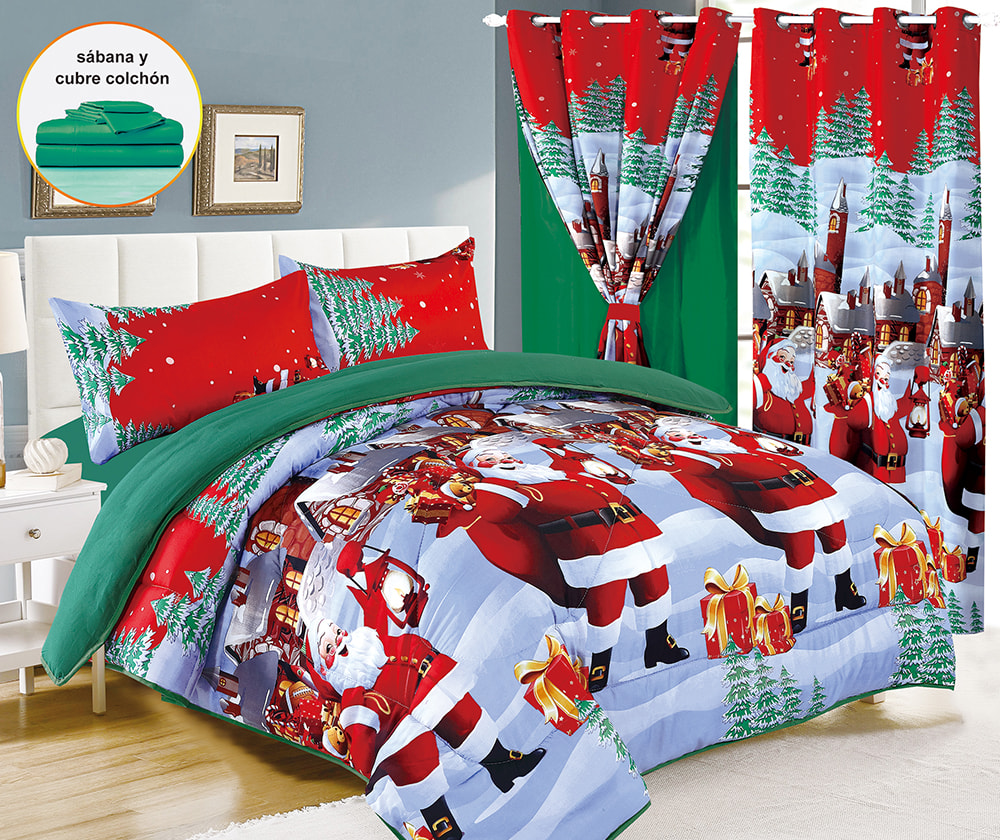
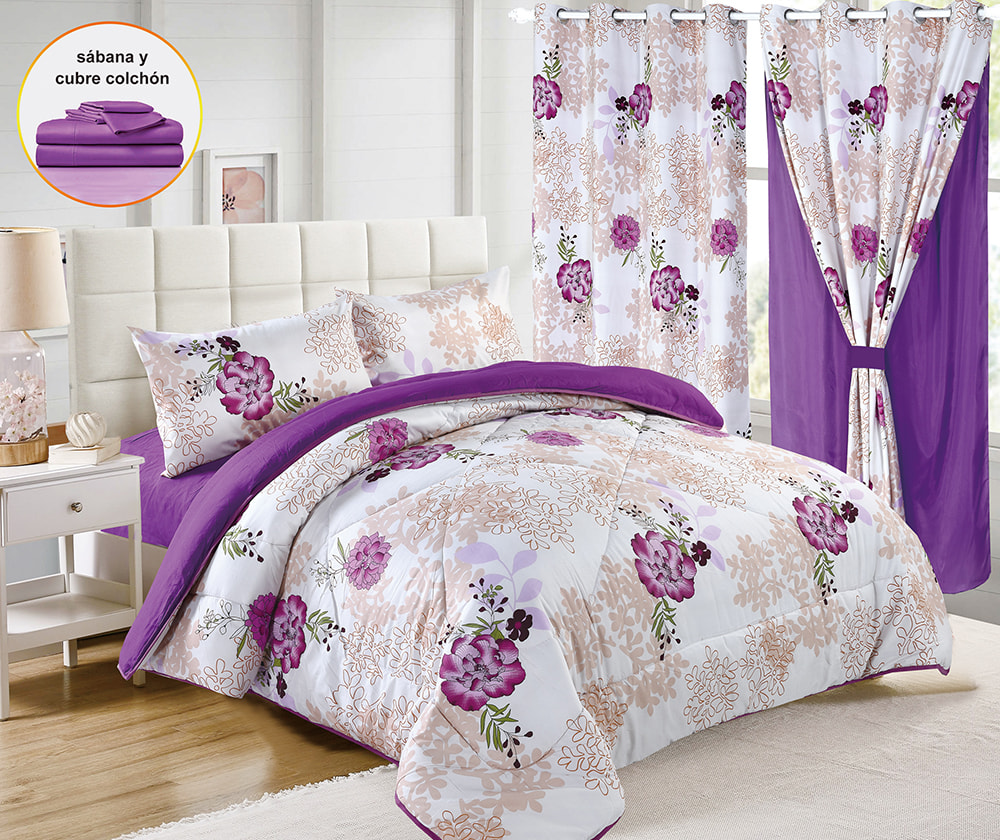
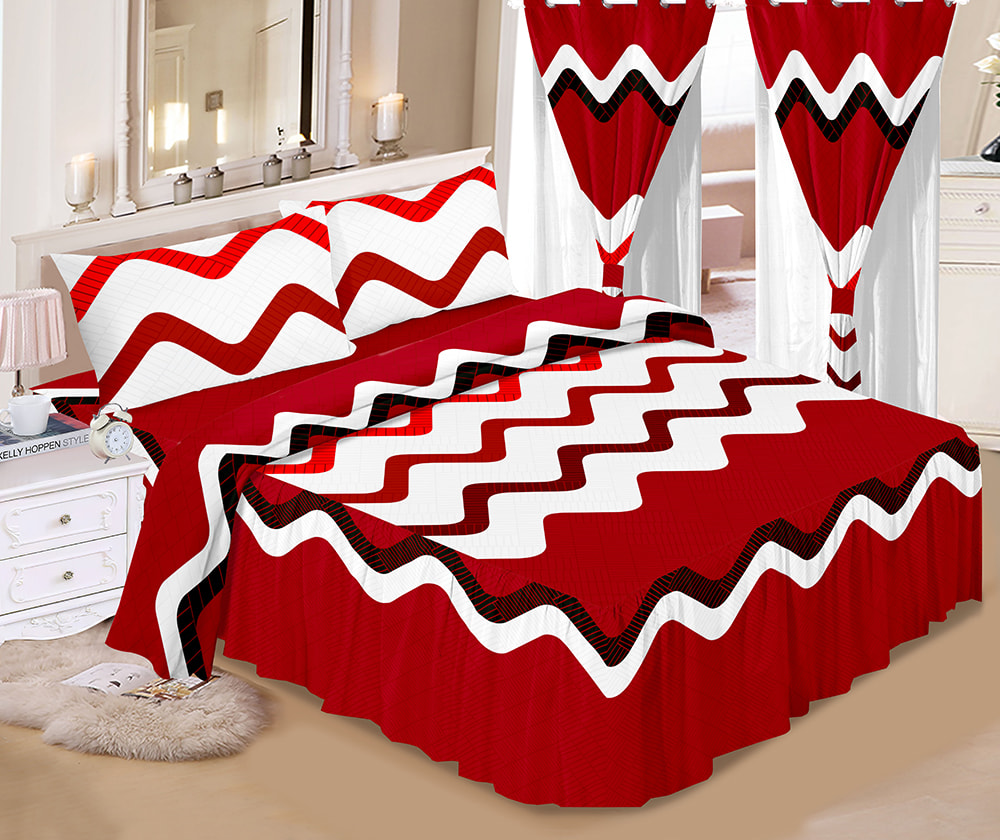
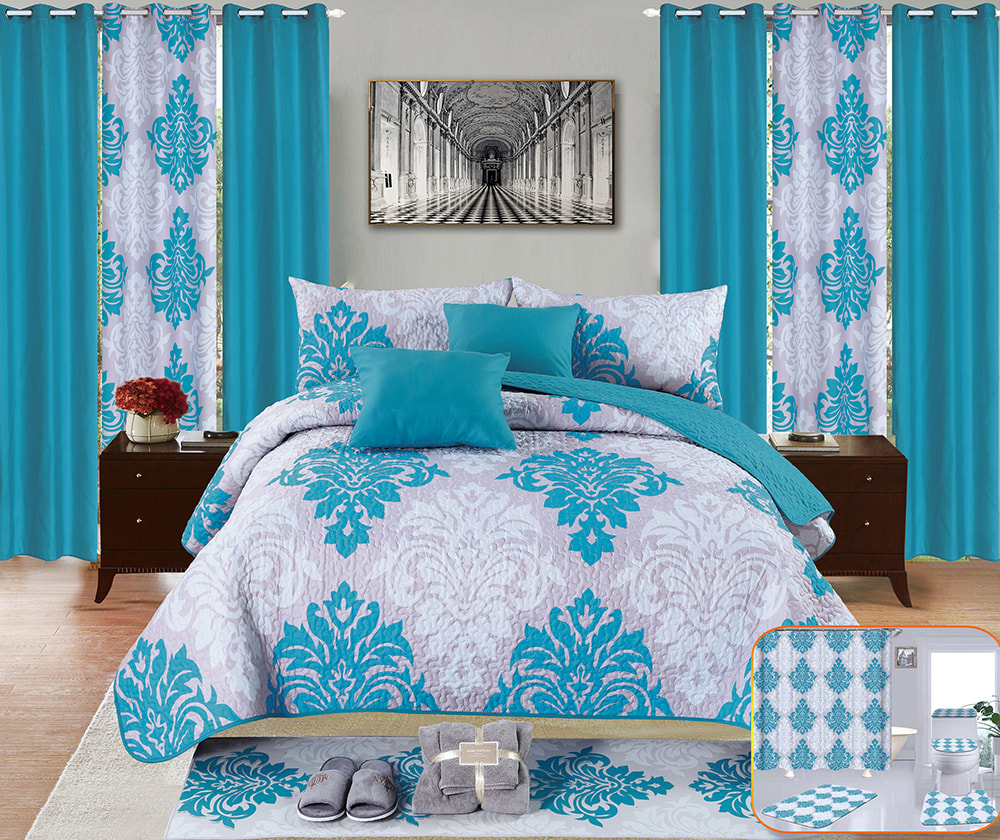
The Home Textile Printed Fitted Sheet 13-Piece Set is designed around this demand. It combines a printed bed sheet, a fitted sheet, pillowcases, curtains, cushion covers, and a floor mat in one coordinated package. Available in queen and king sizes, the set provides a practical way to refresh the principal textile elements of a bedroom without purchasing each item separately.
Its value is not limited to the number of pieces included. The product combines a fresh printed appearance with a soft, breathable polyester fabric, a fitted sheet structure designed to reduce movement, and a selection of complementary home accessories. This integrated approach gives it an advantage over conventional bedding sets that provide only sheets and pillowcases or that require customers to match separate decorative products themselves.
The product is manufactured by Dongyangshi Menghui Textile Co., Ltd., an industrial and trading enterprise specializing in bedding, curtains, pillowcases, cushions, quilts, mattress protectors, and related home textile products. Founded in 2015, the company integrates research and development, production, sales, and export. Its factory covers more than 10,000 square meters and employs more than 100 people, supported by intelligent production equipment, standardized management, and an experienced foreign trade service team.
This article examines the product’s construction, practical advantages, applications, customization potential, and manufacturing strengths. It also explains why a coordinated 13-piece textile set can be commercially attractive to wholesalers, retailers, hospitality buyers, interior furnishing businesses, and households seeking an efficient bedroom upgrade.
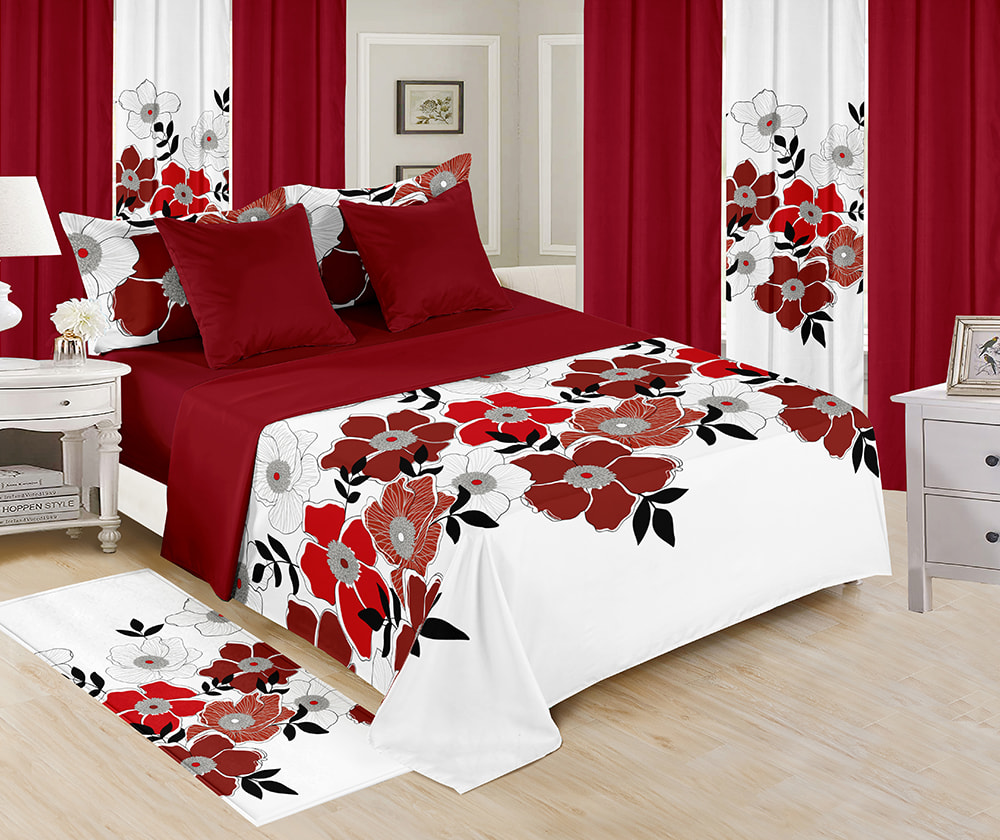
Home Textile Printed Fitted Sheet 13-Piece Set
1. Product Overview and Set Composition
The product is a printed fitted sheet bedding set containing thirteen coordinated pieces. Although the main product category is sheet and fitted sheet sets, the package extends beyond conventional bed linen by including window and decorative accessories. This makes it suitable for customers who want a complete visual arrangement rather than an isolated sheet purchase.
The set is made from 100% polyester, described in the product information as a microfiber polyester luxury sheet material. Polyester microfiber is widely used in home textiles because it can provide a smooth hand feel, light weight, color flexibility, and convenient care when properly constructed. The fabric is suitable for printed designs and can support coordinated patterns across multiple product components.
The primary elements of the set are the flat bed sheet and fitted sheet. The flat sheet provides a conventional upper or covering layer, while the fitted sheet is shaped to cover the mattress and includes a 30-centimeter depth allowance in the listed sizes. This fitted construction is intended to improve coverage and help keep the sheet in position during normal use.
The package also includes pillowcases, curtains, cushion covers, and a floor mat. These items extend the design language from the bed to the surrounding bedroom. The result is a room with greater visual consistency, which can be especially useful for customers who prefer coordinated décor but do not want to spend time selecting individual pieces.
| Component | Quantity | Queen Size | King Size |
|---|---|---|---|
| Bed sheet | 1 piece | 210 × 230 cm | 235 × 270 cm |
| Fitted sheet | 1 piece | 152 × 203 + 30 cm | 198 × 203 + 30 cm |
| Pillowcases | 2 pieces | 50 × 70 cm | 50 × 100 cm |
| Curtains | 6 pieces | 95 × 220 cm | 95 × 220 cm |
| Cushion covers | 2 pieces | 45 × 45 cm | 45 × 45 cm |
| Floor mat | 1 piece | 50 × 150 cm | 50 × 150 cm |
The total is thirteen pieces for each size configuration. The queen and king versions differ primarily in the dimensions of the bed sheet, fitted sheet, and pillowcases, while the listed curtain, cushion cover, and floor mat dimensions remain the same. Buyers should verify mattress measurements, preferred drape coverage, and regional size conventions before placing an order.
2. Coordinated Design for the Complete Bedroom
One of the product’s most important advantages is its coordinated design concept. Traditional bedding purchases often involve selecting a fitted sheet, flat sheet, pillowcases, curtains, cushions, and floor coverings from different collections. Even when the colors appear similar, differences in pattern scale, fabric surface, and color tone can make the finished room look inconsistent.
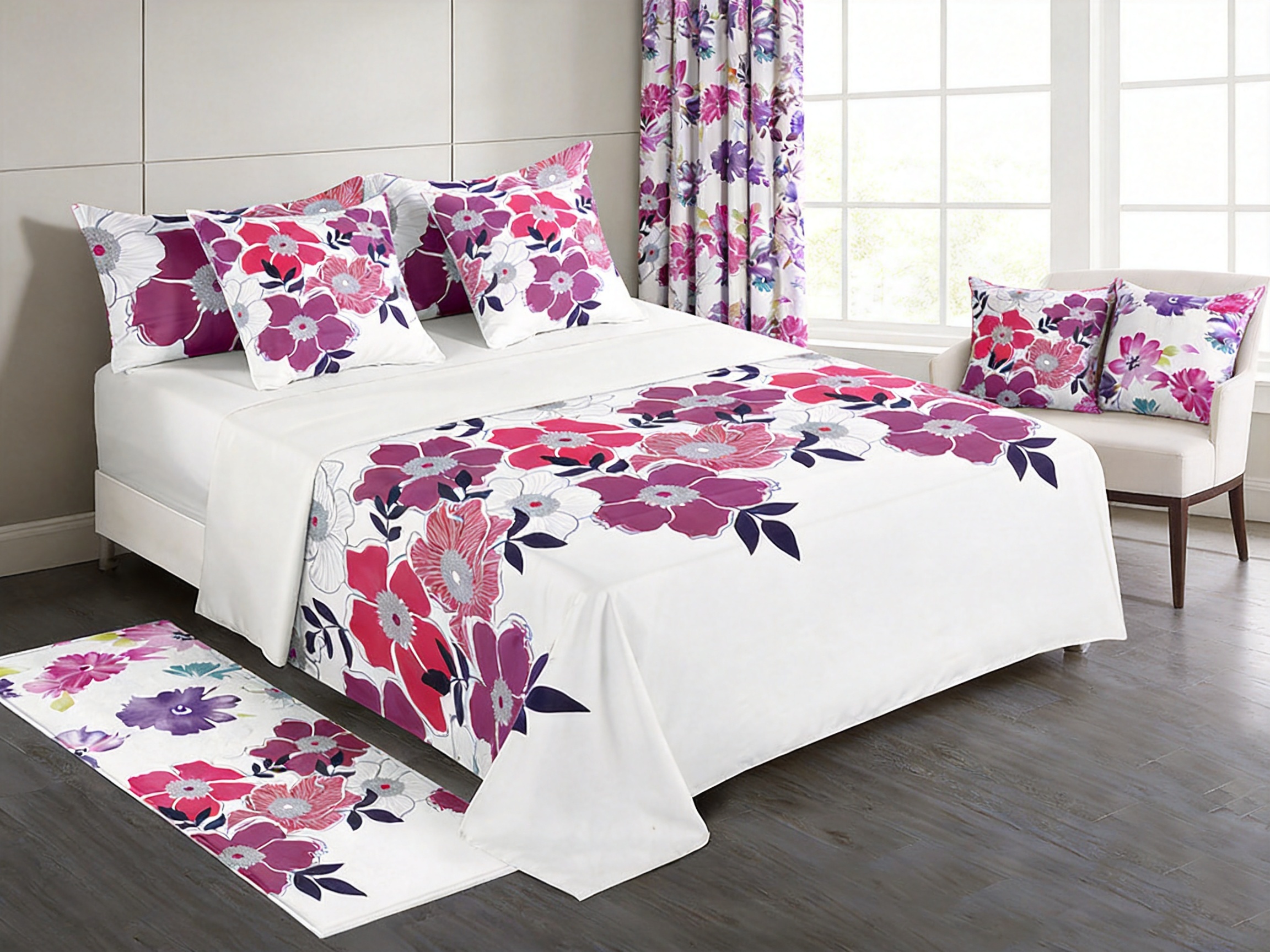
This 13-piece set addresses that problem through a printed design applied across a group of related textile products. The use of fresh and natural colors is intended to create a warm, comfortable, and welcoming bedroom atmosphere. Depending on the selected pattern, the set can support a variety of decorative directions, including relaxed family bedrooms, guest rooms, rental properties, and seasonal room updates.
Coordinated visual design is particularly valuable for retailers. A complete package can be displayed as a finished bedroom concept instead of as separate products on different shelves. This can simplify merchandising, improve the clarity of the purchasing decision, and encourage customers to select a larger package than they might have assembled independently.
For hospitality and property furnishing buyers, the unified appearance can also reduce specification work. A buyer can select one coordinated collection for a room type rather than developing an independent list of bedding and decorative accessories. This may help create consistency across guest rooms, serviced apartments, dormitories, and furnished rental properties.
The printed appearance also gives the set a stronger decorative identity than plain white or solid-color bedding. Plain bedding remains useful for minimalist interiors and institutional applications, but printed designs can provide more immediate visual impact. A printed collection can make a room appear more finished even when the remaining furniture is simple.
3. Comfort and Everyday Fabric Performance
Comfort begins with the fabric that touches the body. The product uses 100% polyester, with the supplied product information referring to a microfiber polyester construction. Microfiber fabrics are formed from very fine fibers that can create a smooth and soft surface. When used in bedding, this type of material is often selected for its pleasant hand feel, lightness, and ability to support detailed printed patterns.
The product description emphasizes softness, breathability, and skin-friendly comfort. These characteristics are important because bedding remains in direct and prolonged contact with the user. A rough surface, excessive stiffness, or poor moisture management can reduce sleep comfort, regardless of how attractive the design may be.
Polyester is also valued by manufacturers for its adaptability. It can be woven or processed into different surface textures, and it accepts a broad range of colors and patterns. This makes it appropriate for product lines that require several designs, coordinated accessories, and repeatable appearance across different production batches.
For daily use, bedding must balance softness with structural stability. A fabric that feels comfortable but loses its shape quickly will not provide long-term value. The product description highlights fine stitching, careful workmanship, fade resistance, and deformation resistance. These qualities are connected to both the fabric selection and the manufacturing controls used during cutting, printing, sewing, inspection, and packing.
Users should follow the care instructions supplied with the specific order. Proper washing temperature, drying method, detergent selection, and storage conditions can help preserve color, surface softness, and dimensional stability. Retailers should communicate care information clearly because correct maintenance contributes to customer satisfaction and reduces avoidable product complaints.
4. The Fitted Sheet Advantage
The fitted sheet is the functional center of the set. Unlike a flat sheet that depends on folding and tucking, a fitted sheet is designed to cover the mattress with shaped corners and an elasticized or fitted structure. The listed dimensions include a 30-centimeter depth allowance, providing coverage for a range of mattress thicknesses within the specified size category.
A properly fitted sheet can remain more stable as the sleeper changes position. It can also reduce the need for repeated adjustment during routine bed making. This is a meaningful advantage over basic flat-sheet packages, particularly for active households, guest rooms, and environments where beds need to be prepared quickly.
The fitted design also improves the visual appearance of the bed. When the sheet is correctly sized, the mattress surface and sides appear more orderly, with fewer loose folds. A neat foundation makes it easier for the flat sheet, quilt, comforter, or duvet to sit evenly on top.
Compared with low-quality fitted sheets, a well-constructed version should provide better corner coverage and more consistent edge tension. The quality of cutting and sewing is important here. Inaccurate dimensions can cause corner lift, excessive tension, or loose areas. Meticulous craftsmanship helps the fitted sheet perform more reliably across repeated use.
Because mattress dimensions vary by market, distributors should treat the listed queen and king dimensions as product specifications rather than universal standards. Before importing or selling the set, buyers should confirm local size terminology, mattress depth expectations, and customer preferences. Clear size labeling is essential for reducing returns and improving the shopping experience.
5. More Than a Bedding Set
Many competing bedding products stop at the bed itself. A standard set may include a fitted sheet, a flat sheet, and two pillowcases, while larger packages may add a duvet cover or decorative pillow shams. This product differentiates itself by extending into several surrounding areas of the bedroom.
The six curtain pieces can contribute to a coordinated window treatment. At 95 × 220 centimeters each, they are designed as relatively narrow panels, allowing buyers to arrange them according to window width, room layout, and preferred fullness. The curtains can help connect the bed’s printed design with the rest of the room.
The two 45 × 45 centimeter cushion covers add a decorative layer. Cushions can be placed on the bed, a chair, a bench, or another seating area. Since the covers are supplied without requiring the customer to purchase separate decorative textiles, they offer a simple way to reinforce the selected pattern.
The 50 × 150 centimeter floor mat completes the package at floor level. It can be positioned beside the bed, at the foot of the bed, or in another suitable area depending on the room layout. A floor mat improves the sense that the package has been designed as a complete bedroom environment rather than as a collection of unrelated bed linens.
This broader composition is a clear point of difference from competitors that offer only basic sheet sets. It can create stronger perceived value because customers receive multiple coordinated products in one purchase. At the same time, it can help retailers create a more distinctive product category between ordinary sheet sets and large luxury bedding collections.
6. Advantages Over Conventional Competitor Products
6.1 Integrated value
A thirteen-piece package gives customers more than a basic sheet set while maintaining a simple purchasing process. Instead of comparing separate curtains, cushion covers, and floor mats, the buyer receives a pre-coordinated group. This can lower the time and effort required to plan a room refresh.
The integrated format can also offer better perceived value than purchasing the same types of products separately. While actual commercial savings depend on pricing, shipping, and distribution conditions, bundling can reduce packaging complexity and support promotional offers. Retailers can present the set as a complete solution rather than competing only on the price of one sheet.
6.2 Coordinated visual identity
Competitor products assembled from unrelated collections may have mismatched colors or patterns. This set uses a unified printed direction across its principal components. The result is more suitable for customers who want a bedroom with a deliberate decorative theme.
6.3 Fitted mattress coverage
The fitted sheet offers a practical advantage over flat-sheet-only packages. Its shaped construction is intended to reduce slipping and improve coverage. This is especially useful for families, frequent-use guest rooms, and customers who prefer a tidy bed with minimal daily adjustment.
6.4 Flexible market positioning
The set can be positioned in several market segments. It may appeal to value-conscious households, decorative home textile shoppers, rental property owners, hospitality buyers, and retailers seeking distinctive bundled merchandise. Its combination of functional bedding and decorative accessories allows it to sit between a basic bedding set and a complete room décor package.
6.5 Design and OEM adaptability
The manufacturer provides customized home textile services based on customer samples. This is important for buyers who need private-label products, exclusive patterns, regional size adjustments, or coordinated collections. A supplier with experience across sheets, quilts, curtains, cushions, and protectors can support broader product development than a factory focused on only one type of textile.
7. Manufacturing Process and Quality-Oriented Production
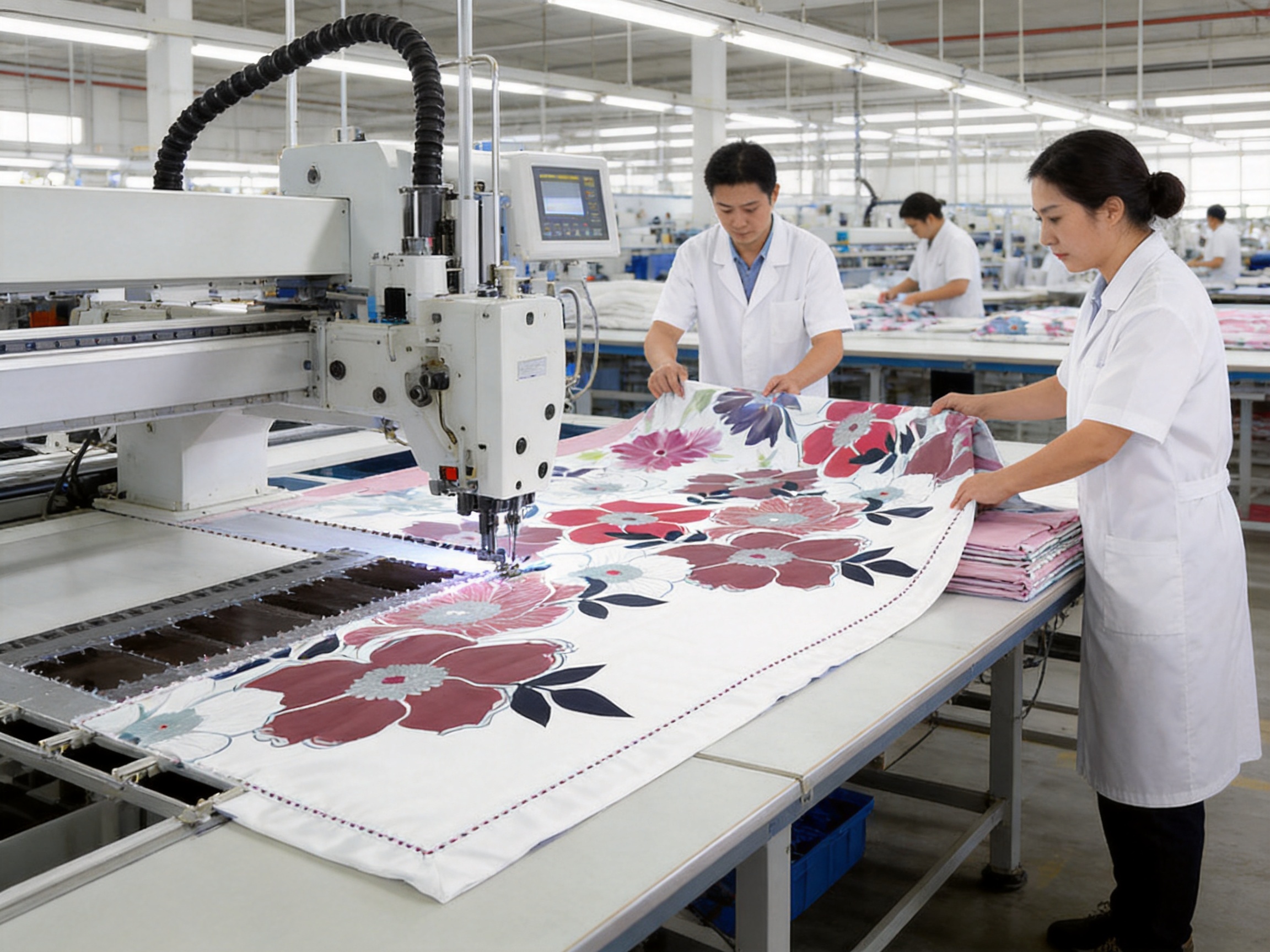
A reliable home textile product depends on more than a fabric specification. Quality is created through a series of connected operations, including product development, material preparation, pattern planning, printing, cutting, sewing, finishing, inspection, and packing. The manufacturer’s integrated industrial and trade structure supports coordination between these stages.
7.1 Research and development
The company integrates research and development with production and sales. This structure allows market feedback to influence product design. For a product such as the 13-piece set, development work may involve selecting suitable pattern layouts, coordinating dimensions, balancing fabric use, and ensuring that the different components can be produced consistently.
Research and development also supports customer-specific projects. When a buyer supplies a reference sample or requests a new design direction, the development team can assess the construction, materials, dimensions, and production requirements before moving toward bulk manufacturing.
7.2 Material preparation
Material preparation is essential for a multi-component product. The same or compatible fabric must be allocated across sheets, curtains, cushion covers, pillowcases, and floor mats. Accurate material planning helps reduce color variation and improves consistency between pieces.
Fabric inspection before cutting can help identify visible defects, uneven surfaces, printing irregularities, or width inconsistencies. When material is checked early, potential problems can be addressed before they spread through a large production order. This is particularly important for printed products, where a defect may be noticeable across a broad surface.
7.3 Printing and pattern control
Printed bedding requires careful control of color, pattern placement, and repeat alignment. The design must remain attractive on large bed sheets while also translating effectively to smaller pillowcases and cushion covers. Curtain panels may require additional attention because repeated panels should present a consistent appearance when hung together.
A standardized production system can help control the relationship between approved samples and finished goods. Color references, production samples, pattern files, and inspection standards should be maintained for each order. Such controls are valuable for private-label and repeat programs, where the buyer expects future production to resemble the original approval sample.
7.4 Cutting and sewing
Cutting accuracy affects both appearance and performance. The fitted sheet requires particular attention because its dimensions must accommodate the mattress surface and depth allowance. The flat sheet, pillowcases, curtains, cushion covers, and floor mat must also be cut according to their individual specifications.
Fine stitching and meticulous workmanship are identified as product strengths. In practical terms, this means seams should be formed consistently, edges should be finished neatly, and stress points should receive suitable reinforcement. Proper sewing contributes to durability and helps reduce fraying, seam opening, and shape distortion during use.
7.5 Intelligent production equipment
The company operates with intelligent production equipment. In home textile manufacturing, equipment support can improve repeatability, production efficiency, and process coordination. Automated or semi-automated machinery may assist with cutting, sewing, quilting, inspection, folding, or packaging, depending on the specific production line.
Equipment alone does not guarantee quality. Its value depends on correct setup, trained operators, preventive maintenance, and process supervision. The combination of intelligent equipment and standardized management can help the factory maintain more consistent output while handling multiple product categories and customer specifications.
7.6 Inspection and finishing
Finished products should be inspected for dimensions, sewing quality, print appearance, stains, loose threads, missing components, and packaging accuracy. Multi-piece sets require a final quantity check because an order can appear complete while one pillowcase, curtain panel, cushion cover, or mat is missing.
Finishing may include thread trimming, pressing, folding, labeling, and set assembly. Proper folding and packaging protect the product during transportation and make the set easier for retailers to display. Clear labels should identify the size, material, component count, and care requirements.
7.7 Standardized management
The company emphasizes a standardized management system. Standardization is particularly valuable when manufacturing products with several sizes and many components. It can support consistent order documentation, production scheduling, sample approval, quality inspection, warehouse control, and export preparation.
For overseas customers, standardized management also improves communication. Specifications can be recorded in a structured format, reducing the risk of confusion about dimensions, quantities, materials, packaging, and design approvals. An experienced foreign trade service team can further support coordination from inquiry through shipment.
8. Manufacturing Capacity and Supplier Strengths
The manufacturer’s factory covers more than 10,000 square meters and has more than 100 employees. This scale provides a foundation for organized production and the handling of multiple home textile categories. The company is not limited to a single bedding item; its product range includes bed sheets, quilt covers, pillowcases, cushions, quilts, waterproof mattress protectors, curtains, and bedding sets.
This product breadth creates several advantages for buyers. A retailer can source related products from one supplier, potentially simplifying communication and product development. A hospitality buyer can request a bedding package and protective textile products from the same manufacturing partner. A brand owner can build a coordinated collection instead of managing separate factories for every product category.
The company’s industrial and trade model also connects factory operations with export services. This can be helpful for international buyers who need assistance with documentation, packaging coordination, production updates, and shipment planning. The supplier’s export experience supports the practical requirements of global trade, although buyers should still confirm order-specific terms and compliance requirements before purchase.
Customization based on customer samples is another significant strength. Sample-based development can be useful when a buyer has an existing design, a market-specific size, a private-label requirement, or a preferred construction detail. The final result depends on the sample, technical specifications, material availability, and approved production standards, so detailed communication remains essential.
The company was founded in 2015, giving it an established operating history in the home textile sector. Its combination of factory resources, product development, production capabilities, and foreign trade support provides a suitable foundation for both standard product orders and customized programs.
9. Applications Across Different Markets
9.1 Household bedrooms
For household users, the set offers a convenient bedroom refresh. The fitted sheet addresses mattress coverage, while the flat sheet and pillowcases support daily bedding needs. Curtains, cushion covers, and the floor mat help create a more complete visual update without requiring extensive interior design work.
9.2 Guest rooms
Guest rooms benefit from coordinated appearance and practical maintenance. A complete textile set can make a room feel more welcoming and organized. Buyers can also keep replacement components available, depending on the intended usage and purchasing plan.
9.3 Furnished apartments and rental properties
Rental properties often require attractive furnishing solutions that can be purchased efficiently. The 13-piece format gives property owners a way to establish a consistent bedroom theme across multiple units. The availability of queen and king sizes provides flexibility for different room layouts.
9.4 Hospitality and accommodation businesses
Hotels, guesthouses, serviced apartments, and other accommodation providers may use coordinated textile products to support a recognizable room style. The curtains and decorative pieces can reinforce the bedding design, while the fitted sheet helps maintain a neat bed presentation.
Hospitality buyers should evaluate the product according to their specific laundering frequency, commercial washing procedures, replacement policy, and performance requirements. A household-oriented product and a heavy-duty institutional product may have different priorities, so testing and specification review are recommended before large-scale deployment.
9.5 Retail and e-commerce
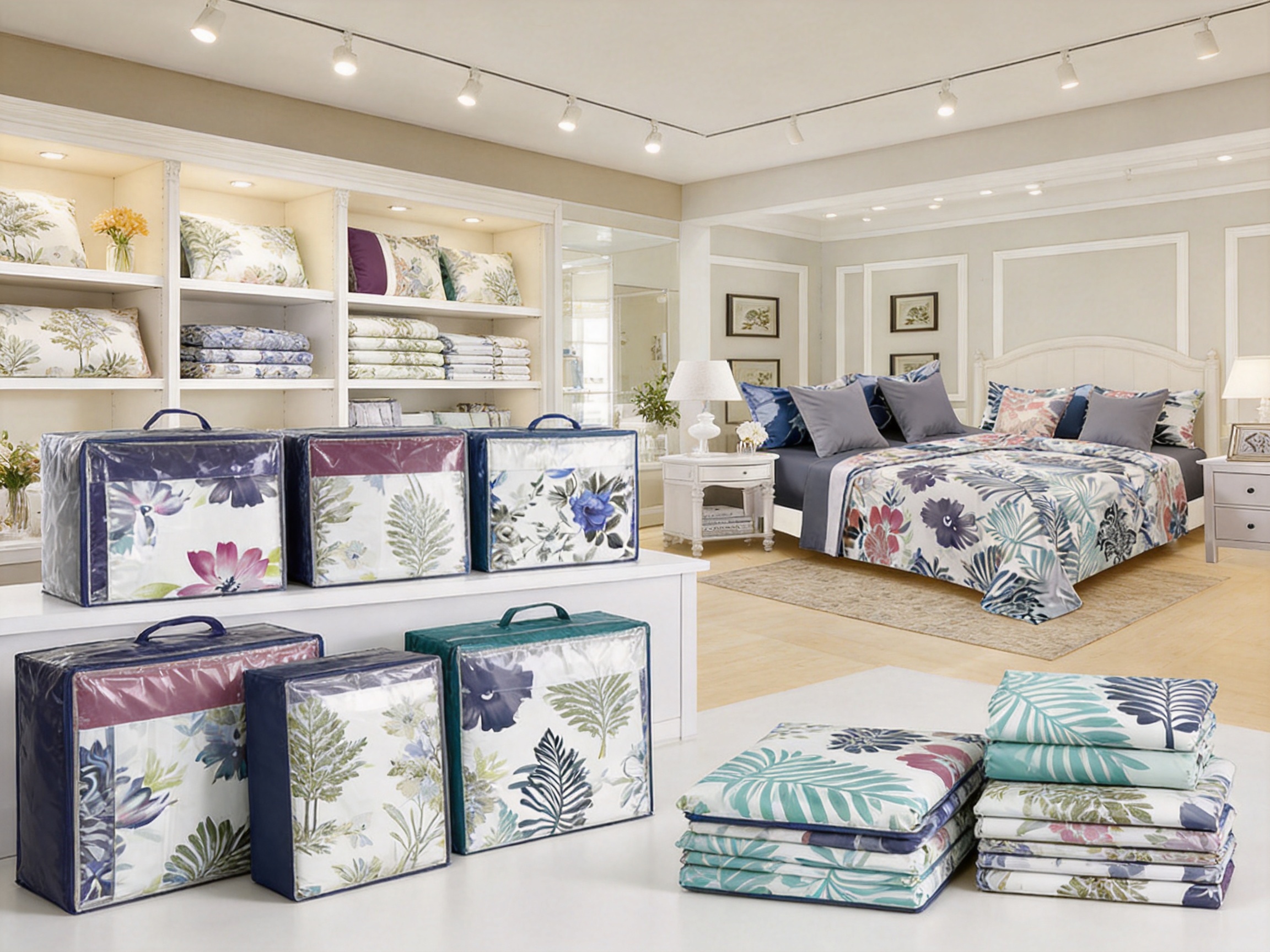
For retailers, the set has strong visual merchandising potential. Product photography can show the coordinated bedroom effect, while packaging can communicate the full component list. Online sellers can emphasize the convenience of purchasing thirteen matching pieces in one order.
Retail listings should clearly distinguish queen and king dimensions. They should also explain that the set includes curtains, cushion covers, and a floor mat in addition to bed linen. Accurate descriptions reduce customer uncertainty and help the product stand apart from ordinary sheet-and-pillowcase packages.
10. Purchasing and Specification Considerations
Before placing an order, buyers should confirm the exact fabric construction. The provided information identifies the material as 100% polyester and also refers to microfiber polyester. If a buyer requires a specific fabric weight, weave, finish, or fiber specification, these details should be included in the technical agreement.
Size verification is equally important. The queen fitted sheet is listed as 152 × 203 + 30 centimeters, while the king fitted sheet is listed as 198 × 203 + 30 centimeters. The “+30 centimeters” notation indicates additional mattress-depth coverage, but buyers should confirm how the factory measures the depth and how the elastic or fitted edge is constructed.
Pattern and color approval should be completed before bulk production. Printed products can appear different under various lighting conditions or on different screens. A physical sample or approved color standard is advisable for commercial programs, especially when the buyer intends to reorder the same design.
Component quantity should be checked carefully. Each set contains one bed sheet, one fitted sheet, two pillowcases, six curtain pieces, two cushion covers, and one floor mat. Buyers should confirm whether the curtains are intended to be used as individual panels, paired arrangements, or another configuration based on the target market.
Packaging requirements may vary by sales channel. Retailers may need individual color boxes, barcode labels, size stickers, multilingual instructions, or compact folding. Wholesale and hospitality buyers may prefer bulk cartons with internal size separation. Packaging should be discussed during the quotation and sample stages.
Buyers should also clarify minimum order quantities, lead times, payment terms, inspection procedures, shipping marks, and replacement policies. These commercial details are not defined by the general product description and must be confirmed for each order.
11. Sustainability and Responsible Product Use
Longer product use is one practical part of responsible textile consumption. Durable stitching, stable construction, and appropriate care can extend the usable life of bedding and reduce the frequency of replacement. The product description emphasizes fade resistance and resistance to deformation, qualities that support continued use when the set is maintained correctly.
Polyester is a synthetic fiber with established industrial recycling possibilities, although actual recyclability depends on the product’s composition, dyes, finishes, mixed materials, and local collection systems. Buyers interested in environmental programs should request detailed information about the fabric, packaging, production practices, and available documentation.
Efficient packaging can also reduce unnecessary material use and transportation volume. Since the set includes multiple pieces, careful folding and packing can help organize the package while maintaining a practical shipping configuration. The final packaging design should balance product protection, retail presentation, and material efficiency.
Responsible use begins with accurate sizing. A correctly fitted sheet is less likely to be discarded because of poor coverage or movement. Providing clear care and sizing information can therefore contribute to better customer satisfaction and fewer avoidable returns.
12. How the Set Supports Modern Home Living
Modern consumers often value convenience, coordinated design, and flexible use. They may not want to spend several weekends selecting individual textiles, comparing patterns, and checking whether colors match. A complete set responds to this lifestyle by reducing the number of purchasing decisions.
The product also supports quick room transformation. A bedroom can receive a new visual identity through the replacement of the main bed linens and selected surrounding accessories. This is useful for seasonal decorating, relocation, guest preparation, rental turnover, or simple personal preference changes.
The combination of soft fabric and decorative printing serves both functional and emotional needs. Bedding must feel comfortable and perform reliably, but it also influences how a room feels. Fresh colors and coordinated patterns can make the bedroom appear warmer, more personal, and more complete.
For businesses, the same characteristics translate into merchandising value. A complete set is easy to explain, easy to display, and suitable for lifestyle-oriented marketing. Retailers can present it as a ready-made bedroom solution, while interior furnishing companies can use it as part of a broader room package.
13. Comparison with Other Bedding Formats
| Product Format | Main Contents | Primary Strength | Limitations Compared with This Set |
|---|---|---|---|
| Basic sheet set | Fitted sheet, flat sheet, and pillowcases | Simple and economical bedding replacement | Usually does not include curtains, cushions, or floor coverings |
| Duvet cover set | Duvet cover and pillowcases | Useful for changing the appearance of a duvet | May not include a fitted sheet or coordinated room accessories |
| Quilt or comforter set | Filled quilt or comforter with matching covers | Adds warmth and visual weight | May be less flexible for warm climates or customers who already own a duvet |
| Plain institutional bedding | Basic sheets and pillowcases | Easy standardization and simple appearance | Offers less decorative impact and no integrated room styling |
| Printed 13-piece fitted sheet set | Sheets, fitted sheet, pillowcases, curtains, cushion covers, and floor mat | Combines bedding, coordinated design, and broader room coverage | Requires careful size and component verification before purchase |
This comparison shows the product’s position in the market. It is not simply a larger version of a basic sheet set. Its distinctive value comes from combining mattress textiles with decorative bedroom accessories. It also differs from a duvet-focused package because it does not depend on including a filled duvet or comforter.
14. Quality Communication Between Buyer and Manufacturer
Successful textile production depends on precise communication. Buyers should provide clear information about the intended market, product dimensions, fabric preferences, print requirements, packaging, labeling, and inspection expectations. A detailed specification sheet can reduce misunderstandings and support smoother production.
When a customer supplies a sample, the manufacturer should review the sample’s material, construction, measurements, stitching, print appearance, and packaging concept. If the buyer wants changes, those changes should be recorded in writing and reflected in an approved pre-production sample.
Color approval is especially important for a coordinated set. The printed pattern should be checked on the main sheet, fitted sheet, pillowcases, curtains, cushion covers, and floor mat. Minor differences caused by fabric surface or production conditions should be discussed before bulk manufacturing.
Buyers should also agree on acceptable tolerances. Textile dimensions may have reasonable manufacturing tolerances, but the limits should be documented. This is particularly relevant for fitted sheets, curtain panels, and products intended for standardized retail packaging.
Inspection can take place during production, before packing, or through a final pre-shipment inspection. The chosen method should reflect order size, product complexity, and buyer requirements. A complete inspection should include both appearance and set completeness.
15. Commercial Benefits for Wholesale and OEM Buyers
For wholesale buyers, the product offers an opportunity to expand beyond conventional bed linen. Its thirteen-piece composition can create a distinctive stock-keeping unit with a clear value proposition. Retailers may use it in seasonal campaigns, bedroom makeover promotions, wedding and moving-home collections, or home furnishing displays.
For OEM buyers, customization can create differentiation. A buyer may request an exclusive print, private label, alternative packaging, or adjustments to the accessory combination. The manufacturer’s experience in multiple home textile categories makes it possible to discuss a broader coordinated collection rather than a single isolated item.
For international distributors, supplier consolidation may reduce the complexity of managing several product categories. Sheets, fitted sheets, curtains, cushions, quilts, and waterproof mattress protectors can be discussed with one experienced home textile partner. This does not eliminate the need for quality control, but it can simplify product planning and communication.
For hospitality buyers, the set may help create a consistent room concept. A buyer could select one pattern for a particular room tier or property style, subject to commercial laundering and durability evaluations. The coordinated accessories can support a more finished appearance than bedding alone.
16. Product Presentation and Merchandising Recommendations
The product should be presented as a complete bedroom solution. Retail displays can show the fitted sheet on a mattress, the flat sheet arranged on top, and the curtains, cushion covers, and floor mat positioned nearby. This arrangement helps customers understand why the product contains more value than a standard sheet package.
Product descriptions should state the material, total piece count, available sizes, individual dimensions, and complete contents. The difference between queen and king pillowcase sizes should be visible. Online listings should use clear photographs of the full set as well as close views of the fabric and stitching.
Retailers should avoid describing the product as including a duvet cover or comforter unless the order has been specifically changed to include one. The supplied configuration contains a bed sheet, fitted sheet, pillowcases, curtains, cushion covers, and floor mat. Accurate representation protects customer trust.
Color names should be specific enough to guide customers but should not replace the approved product images or physical samples. Printed textiles may look different depending on screen settings and ambient light. A sample service can be useful for wholesale and project buyers.
17. Care, Maintenance, and Long-Term Use
Care instructions should be followed according to the final product label. In general, users should sort printed textiles by color, avoid unsuitable bleaching products, select an appropriate washing cycle, and ensure that the items are fully dry before storage. Excessive heat or aggressive treatment may affect color and fabric performance.
The fitted sheet should be removed carefully rather than pulled forcefully from one corner. This reduces unnecessary stress on the fitted edge and stitching. Curtains and cushion covers should also be handled according to their specific finishing and washing requirements.
Regular inspection can help identify loose threads, damaged seams, or worn edges before a minor issue becomes more serious. Proper storage in a dry, ventilated location helps protect the fabric from moisture and unwanted odors.
For commercial users, laundering procedures should be tested before full deployment. The appropriate washing temperature, drying process, detergent, and folding method may differ between household and industrial equipment. A controlled care program can support more consistent appearance and service life.
18. Why Manufacturing Integration Matters
Manufacturing integration is important because a coordinated textile set contains different product types with different construction requirements. A curtain panel is not sewn in exactly the same way as a fitted sheet, and a floor mat may require different edge treatment from a pillowcase. A supplier experienced across these categories is better positioned to coordinate the complete package.
Integration also supports design consistency. The same pattern concept must be adapted to large and small product surfaces while maintaining a coherent appearance. A supplier that manages development, production, and export internally can make communication more direct throughout this process.
The company’s combination of research and development, production, sales, and export services provides a platform for this type of coordinated manufacturing. Its factory scale, intelligent equipment, standardized management system, and experienced team support the needs of buyers seeking both standard and customized home textile products.
These strengths are relevant to the product’s competitive position. The set is not only attractive because it contains thirteen pieces. It is also supported by a production organization capable of handling varied textile components, detailed specifications, repeat orders, and international commercial requirements.
19. Q&A
Q1: What is included in the 13-piece set?
The set includes one bed sheet, one fitted sheet, two pillowcases, six curtain pieces, two cushion covers, and one floor mat. Together, these components make thirteen pieces.
Q2: What material is used?
The listed material is 100% polyester, with the product information describing it as microfiber polyester. Buyers requiring a specific weight, weave, or finish should confirm the technical specification before ordering.
Q3: Is a duvet cover or comforter included?
No duvet cover or filled comforter is listed in the standard configuration. The package is centered on a bed sheet, fitted sheet, pillowcases, curtains, cushion covers, and a floor mat.
Q4: Which sizes are available?
The product is listed in queen and king sizes. The queen fitted sheet measures 152 × 203 + 30 centimeters, and the king fitted sheet measures 198 × 203 + 30 centimeters. Other components also have separate listed dimensions.
Q5: What is the benefit of the fitted sheet?
The fitted sheet is designed to cover the mattress more securely than a conventional flat sheet. Its shaped construction and 30-centimeter depth allowance are intended to reduce slipping and improve bed neatness.
Q6: Are the curtains and bedding designed to match?
Yes. The product is presented as a coordinated printed set, with the curtains, cushion covers, and floor mat intended to complement the bed linen and create a unified bedroom appearance.
Q7: Can the product be customized?
The manufacturer provides customized home textile services based on customer samples. Buyers can discuss designs, measurements, packaging, labeling, and other requirements with the production and export team.
Q8: Is the set suitable for wholesale purchasing?
Yes. Its complete composition, multiple size options, and coordinated design make it suitable for retailers, distributors, hospitality buyers, furnished property operators, and other wholesale customers.
Q9: What manufacturing strengths support the product?
The manufacturer operates a factory covering more than 10,000 square meters, employs more than 100 people, uses intelligent production equipment, and follows a standardized management system. It integrates research and development, manufacturing, sales, and export services.
Q10: What should buyers confirm before placing an order?
Buyers should confirm fabric details, size measurements, print colors, component quantities, packaging, labeling, minimum order quantities, lead times, inspection arrangements, shipping terms, and any customization requirements.
Q11: Can the fitted sheet fit every queen or king mattress?
Mattress dimensions and terminology can vary by market. Buyers should compare the listed product measurements with the actual mattress size and depth before ordering. The supplier should also confirm the applicable measurement tolerance.
Q12: Who can benefit most from this product?
Households, retailers, online sellers, guesthouse operators, furnished rental owners, hospitality businesses, and OEM buyers can all benefit from the set’s coordinated design and broad component range.
20. Conclusion
The Home Textile Printed Fitted Sheet 13-Piece Set offers a practical combination of bedding comfort, mattress coverage, decorative coordination, and purchasing convenience. Its 100% polyester microfiber-style fabric supports a soft hand feel and flexible printed design, while the fitted sheet provides a more secure foundation than a flat-sheet-only arrangement.
Its strongest market distinction is the inclusion of six curtain pieces, two cushion covers, and a floor mat alongside the bed sheet, fitted sheet, and pillowcases. This transforms the product from a conventional bedding package into a coordinated bedroom furnishing solution. For consumers, it simplifies room decoration. For retailers and project buyers, it creates a clear bundled product with strong visual merchandising potential.
The product is further supported by a manufacturer with experience in research and development, home textile production, export, and customer-specific services. A factory of more than 10,000 square meters, a workforce of more than 100 employees, intelligent production equipment, standardized management, and a broad product range provide a solid foundation for consistent manufacturing and coordinated OEM development.
For the best purchasing outcome, buyers should verify dimensions, material details, pattern approvals, packaging, care instructions, and commercial terms before production. With accurate specification and suitable quality control, this 13-piece printed fitted sheet set can serve as an attractive and efficient solution for modern bedrooms, retail collections, furnished properties, and hospitality environments.
References
1. Product specification sheet for the Printed Fitted Sheet 13-Piece Set, including material, component quantities, sizes, and dimensions.
2. Manufacturer information regarding factory scale, product categories, research and development, intelligent production equipment, standardized management, and export services.
3. General textile manufacturing principles concerning fabric preparation, printing, cutting, sewing, inspection, finishing, and packaging.
4. General home textile care and maintenance practices for polyester bedding, curtains, cushion covers, and floor mats.
5. General retail and hospitality merchandising principles for coordinated bedroom textile collections.
Product: Home Textile Printed Fitted Sheet 13-Piece Set
Contact Us for More Details
Don't hesitate to contact when you need us!
Contact Information
Add:
Building 1, East Area, Wanyang Zhongchuang City, Economic Development Zone, Dongyang City, Zhejiang Province, China
Phone:
Tel:
E-mail:
Quick Links
Product Category
QR Code


+86-13616899966
+86-579-86610966
