 English
 русский
 Español
 عربى


Printed Six-Piece Bedspread Set with Double-Layer Curtains: A Coordinated Home Textile Solution
Creating a comfortable and visually unified bedroom requires more than selecting an attractive bed covering. The bed, windows, pillows, and surrounding textiles all contribute to the atmosphere of the room. When these elements are purchased separately, differences in color, pattern, fabric texture, and proportions can make the room appear unfinished. A coordinated bedding and curtain set offers a practical solution by bringing the principal soft furnishings together in one carefully matched collection.
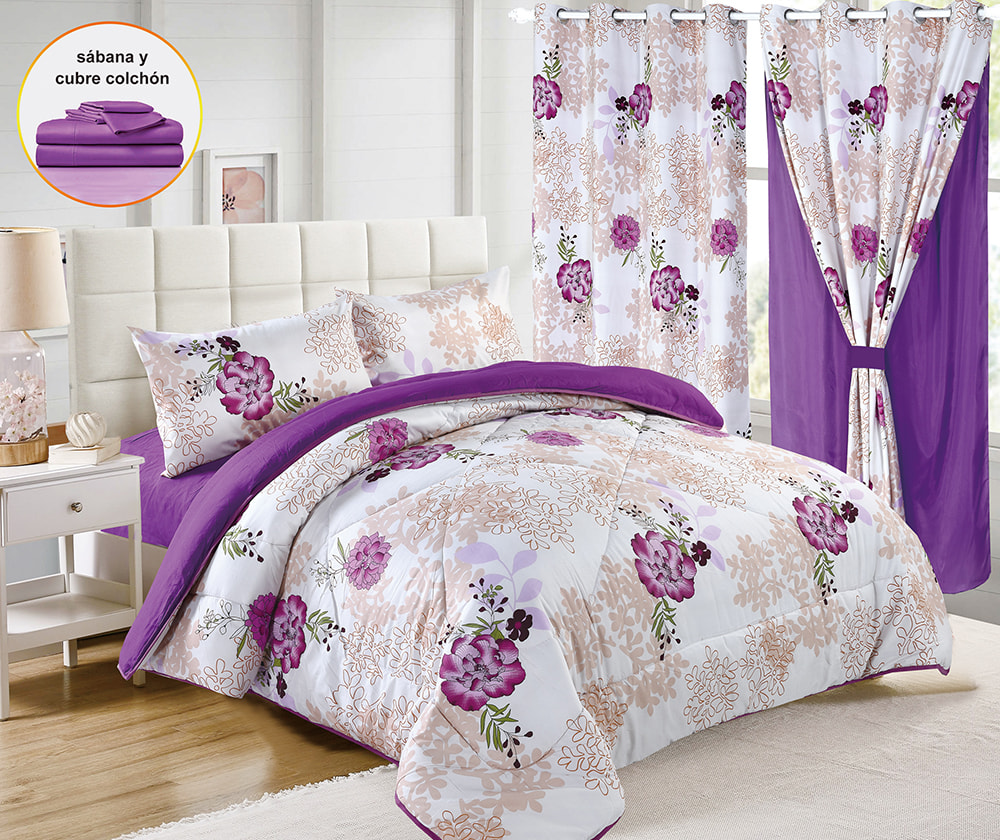
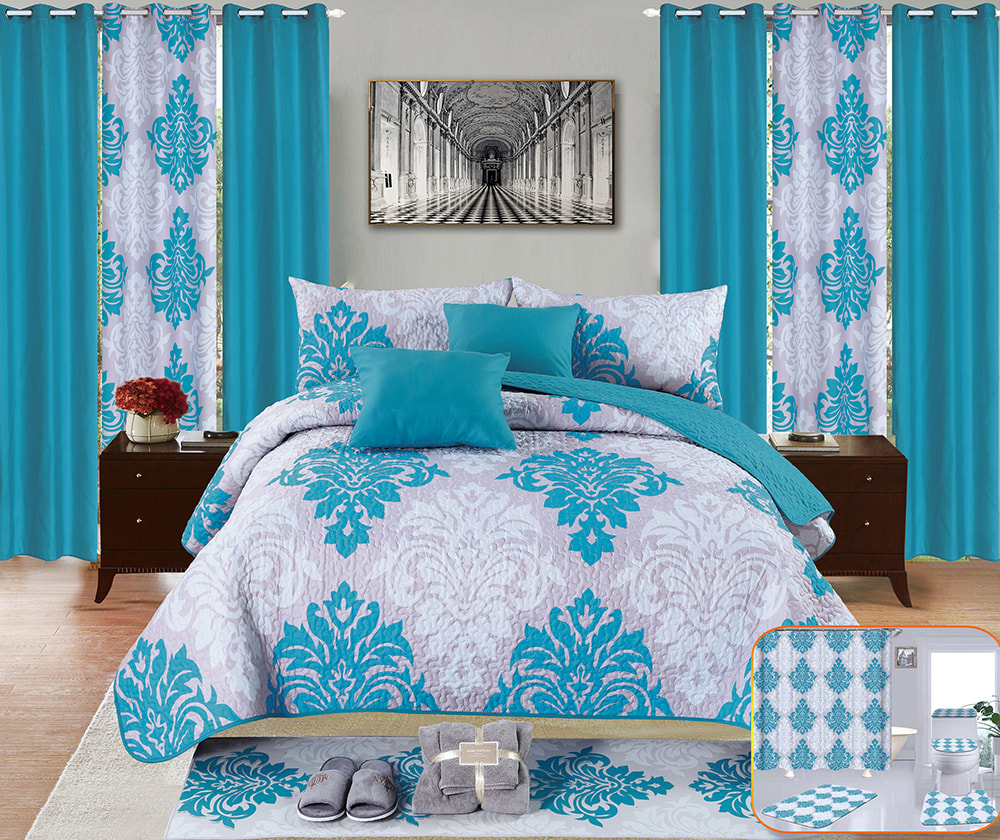
The printed six-piece bedspread set with double-layer curtains is designed for households, hospitality projects, retailers, distributors, and interior furnishing suppliers seeking a complete bedroom textile solution. The set combines a bed sheet, a bed skirt, two pillowcases, and two curtains in a unified printed design. Its composition provides the visual impact of a coordinated bedroom arrangement while reducing the time and uncertainty involved in sourcing individual products.
Produced from 100% polyester fabric, the set is intended to provide a soft hand feel, breathable everyday comfort, dependable color performance, and practical durability. The printed surface creates a decorative focal point, while the double-layer curtain structure adds both ornamental appeal and useful light-management performance. Together, the bedding and curtains can help transform an ordinary bedroom into a warmer, more organized, and more inviting living space.
For buyers comparing this product with conventional bedding-only packages or separately sourced curtain combinations, its principal advantage is integration. The set is not merely a collection of unrelated textile items. It is developed around a coordinated visual concept, compatible dimensions, efficient production, and the needs of modern home textile distribution.
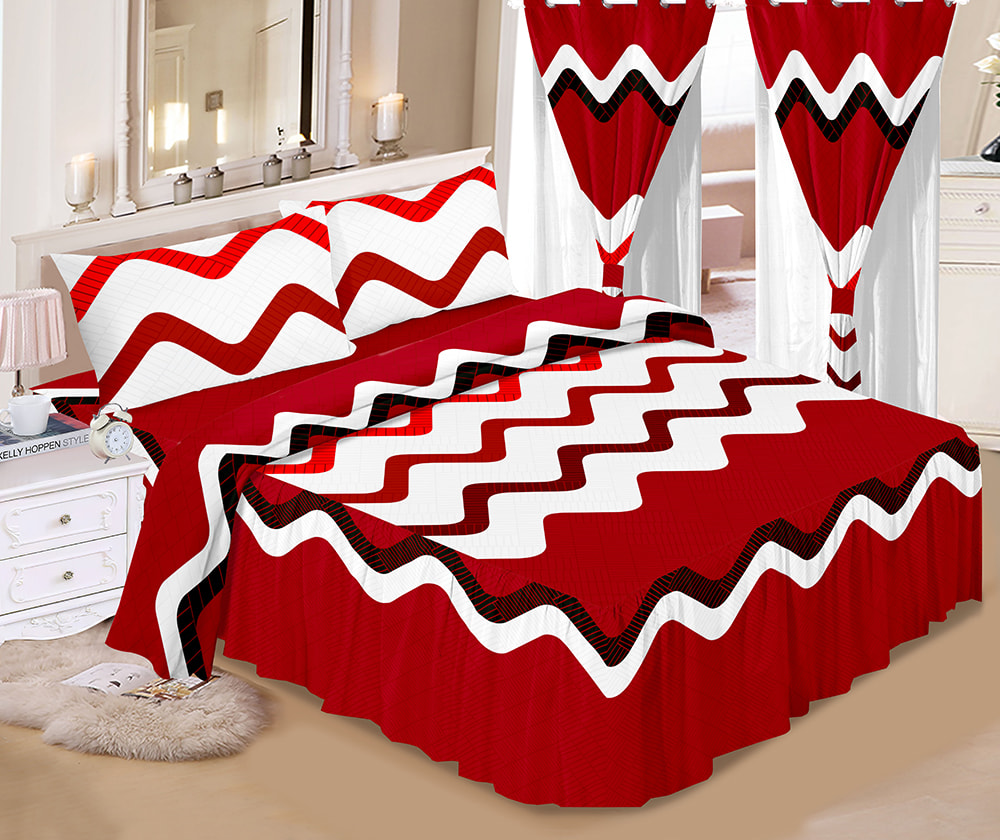
Printed 6-Piece Bedspread Set With Double-Layer Curtains
Product Overview and Six-Piece Composition
The product is a printed six-piece bedspread set with double-layer curtains. Although it is categorized within curtain-related home textiles, its complete design covers several important bedroom furnishing requirements. The coordinated set includes one bed sheet, one bed skirt, two pillowcases, and two curtain panels. This arrangement provides a complete decorative foundation for a bedroom without requiring the purchaser to match separate products from different suppliers.
The product name may also be presented as a printed bed skirt six-piece set with double curtains. In commercial catalogs, it can be positioned as a luxury sheet set, printed bedding collection, coordinated bedroom set, or home textile package. This flexibility makes it suitable for different sales channels, including home furnishing stores, bedding retailers, online marketplaces, hotel supply programs, interior design projects, and private-label collections.
| Component | Quantity | Available Dimension | Function |
| Bed sheet | 1 piece | Queen: 210 × 230 cm; King: 235 × 270 cm | Primary sleeping surface and decorative bed covering |
| Bed skirt | 1 piece | Queen: 152 × 198 + 30 + 40 cm; King: 198 × 203 + 30 + 40 cm | Creates a finished appearance around the mattress and bed base |
| Pillowcase | 2 pieces | Queen: 50 × 70 cm; King: 50 × 100 cm | Coordinates the pillows with the main bedding design |
| Curtain | 2 pieces | 120 × 220 cm each | Provides coordinated window decoration and light management |
The dimensional structure supports two principal size options: Queen and King. The Queen configuration includes a 210 × 230 centimeter bed sheet, a 152 × 198 centimeter bed skirt with additional drop and construction measurements, two 50 × 70 centimeter pillowcases, and two 120 × 220 centimeter curtains. The King configuration includes a 235 × 270 centimeter bed sheet, a 198 × 203 centimeter bed skirt with additional drop and construction measurements, two 50 × 100 centimeter pillowcases, and two 120 × 220 centimeter curtains.
Because bedding dimensions can vary among markets and mattress systems, buyers should confirm the preferred size before placing an order. The stated dimensions provide a clear production reference, while professional suppliers can discuss size grading, labeling, packaging, and possible customization requirements for particular sales regions.
Coordinated Design for a Complete Bedroom Appearance
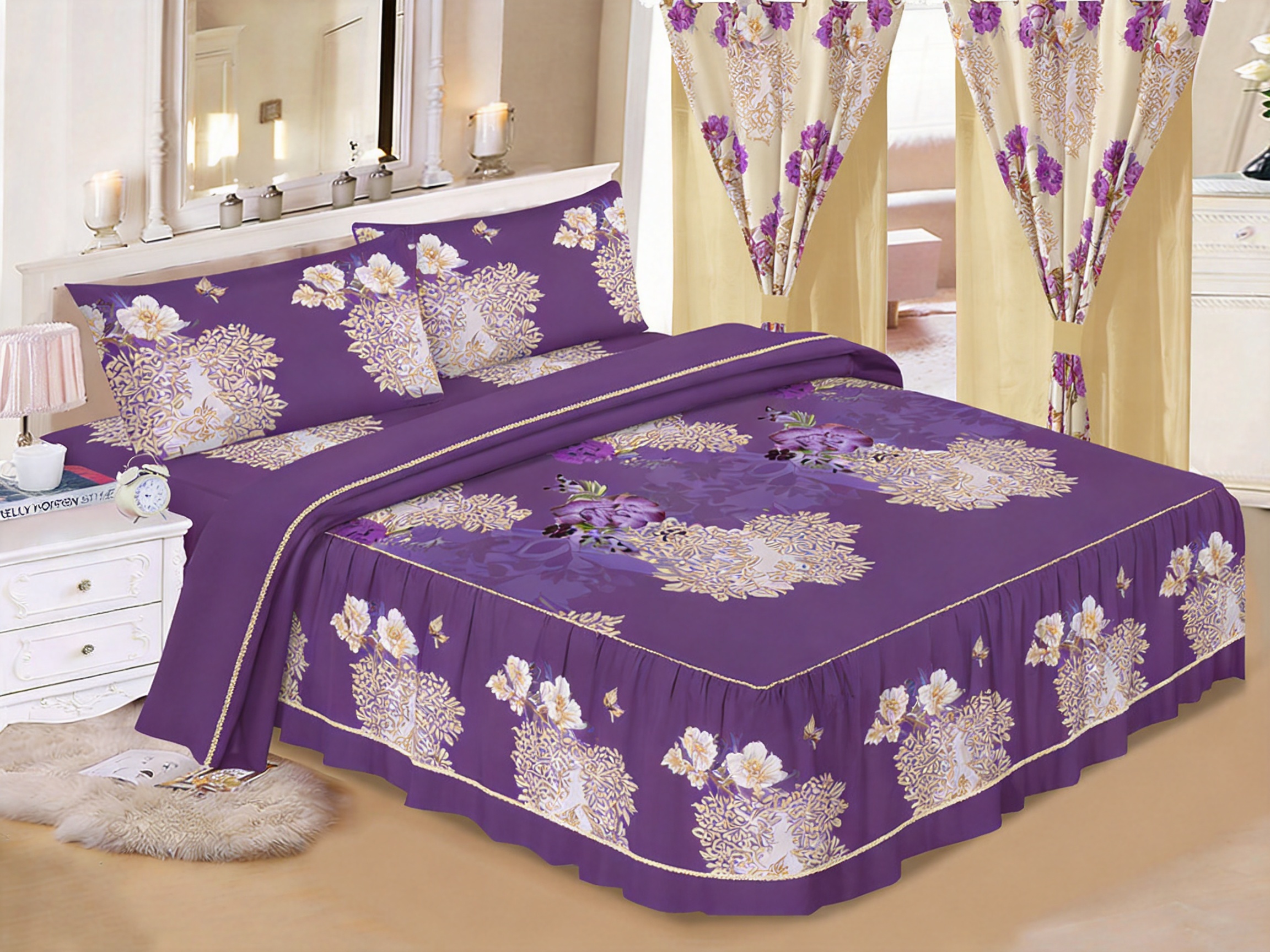
One of the most important strengths of this product is the coordinated relationship between its components. The bedspread, bed skirt, pillowcases, and curtains share a matching printed style, allowing the entire bedroom to follow one visual direction. This coordinated treatment is particularly valuable in rooms where the bed occupies the central position and the windows are visible from the main entrance or sleeping area.
Matching textiles can make a room appear more deliberate and spacious. When the patterns and colors are related, the eye moves naturally from the bed to the windows instead of being interrupted by unrelated decorative choices. This can be useful in compact bedrooms, guest rooms, serviced apartments, dormitories, vacation properties, and model rooms where a strong first impression is important.
The printed surface also gives buyers an efficient method of introducing color and personality. Rather than depending on multiple decorative accessories, the set can establish the principal theme of the room through its coordinated pattern. Additional furnishings can then remain simple and neutral. This approach reduces the need for excessive decoration while still delivering a distinctive interior appearance.
For retailers, a coordinated set is easier to merchandise than multiple separate products. It can be displayed as a complete bedroom solution, photographed in a single lifestyle setting, and promoted through seasonal or room-makeover campaigns. Customers can understand the value immediately because the contents are visually connected and functionally complementary.
The printed colors are designed to remain attractive over continued use. The product description emphasizes rich, long-lasting color performance and resistance to fading. While actual color durability depends on laundering conditions, detergent selection, exposure to direct sunlight, and usage intensity, the intended construction supports a reliable decorative appearance for everyday home environments.
Fabric Characteristics and Everyday Comfort
The set is made from 100% polyester, described in the product information as microfiber polyester. Polyester is widely used in modern bedding and curtain production because it offers a useful balance of softness, strength, dimensional stability, color retention, and production efficiency. When processed with an appropriate microfiber construction, the fabric can provide a smooth and delicate surface that feels comfortable against the skin.
Softness is an important purchasing factor for bedding. The bed sheet and pillowcases come into direct and repeated contact with the user, so a pleasant hand feel can strongly influence satisfaction. The fabric used for this product is intended to feel soft, fine, and skin-friendly rather than rough or excessively rigid. This makes the collection suitable for bedrooms used throughout the year.
Breathability is another desired quality in household bedding. No fabric can eliminate the influence of room temperature, mattress materials, personal sleeping habits, or seasonal conditions, but a well-constructed textile can support a more comfortable sleeping environment by allowing air movement through the surface structure. The product is presented as breathable and suitable for all-season use, giving retailers a versatile option rather than a strictly summer or winter product.
Polyester also provides practical benefits for large-scale production and daily household care. It generally offers good resistance to stretching and shrinking when handled correctly. Its durability is useful for families, guest rooms, rental properties, and commercial environments where bedding may be washed regularly. The relatively stable fabric structure also helps the product maintain its overall shape during storage, transportation, and display.
For competing products made from less stable or less carefully finished materials, advantages may include improved resistance to deformation, easier coordination of multiple components, and more consistent appearance after repeated use. These benefits are especially important for distributors who need products that can meet the expectations of both retail customers and institutional buyers.
Comfort in Different Seasons
The set is suitable for all-season bedroom styling because its components are not limited to a specific climate or decorative period. In warmer months, the printed bed sheet can contribute to a light and orderly bed arrangement. During cooler seasons, it can be layered with quilts, comforters, blankets, or other insulating bedding according to local needs.
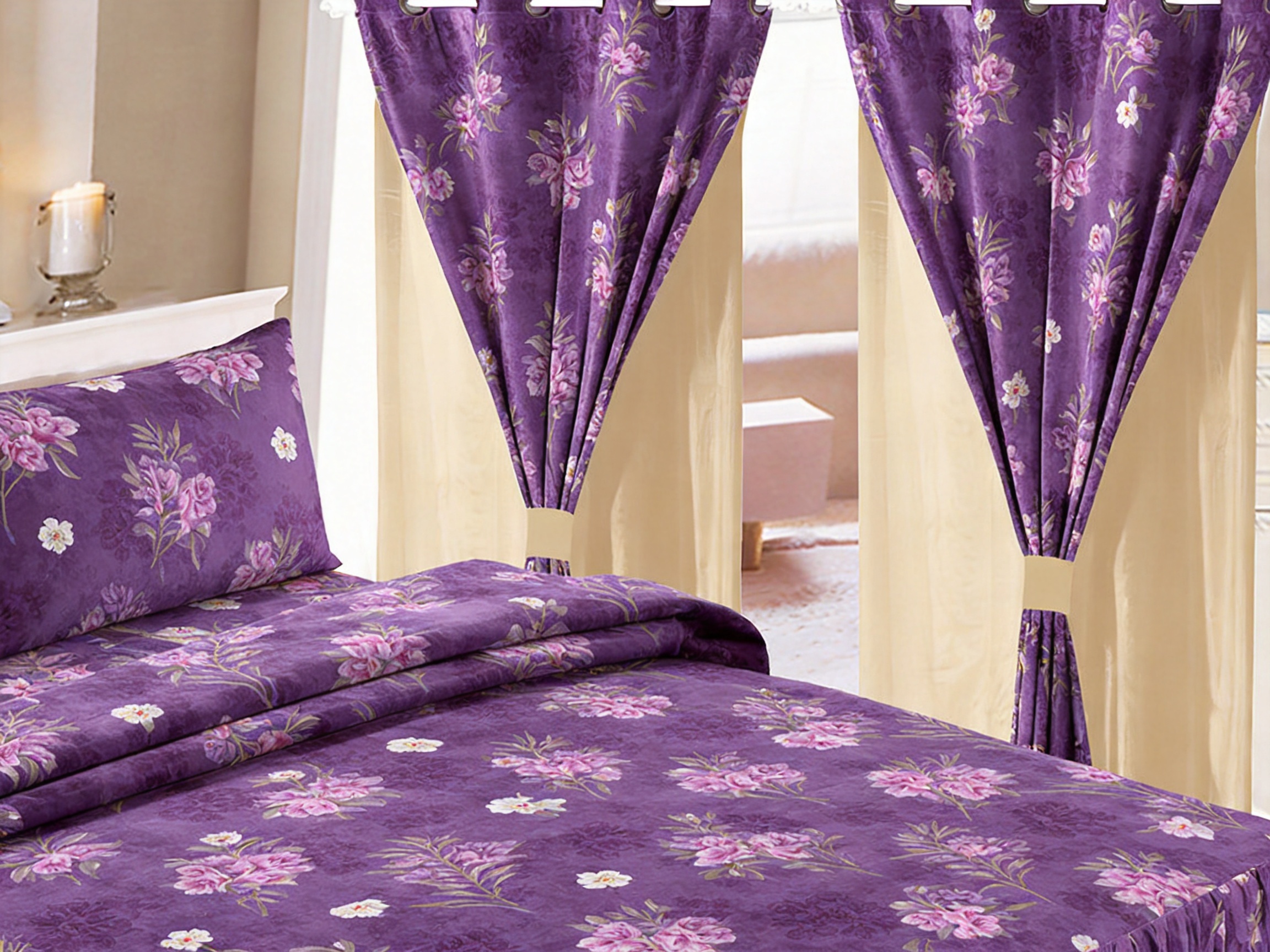
The curtains also support year-round use. Their decorative outer appearance can remain relevant as seasonal bedding changes around them. Depending on the window, lining, and room conditions, the double-layer structure may help reduce incoming light and contribute to a more comfortable environment for rest. This makes the set suitable for bedrooms where consistent visual styling is preferred across the year.
Double-Layer Curtains: Decorative and Functional Value
The two curtain panels are a defining feature of this collection. A single-layer curtain may provide decoration, privacy, or modest light filtering, but a double-layer arrangement can combine separate textile functions more effectively. The product description identifies the curtains as double-layered and emphasizes their ability to integrate light-blocking and decorative roles.
Light control is important in bedrooms. Morning sunlight, street lighting, neighboring buildings, and changing daylight levels can influence sleep quality and perceived privacy. By adding a second layer, the curtains can help regulate the amount of light entering the room. The precise level of light reduction depends on the fabric construction, installation method, color, window orientation, and surrounding environment, but the layered design provides greater flexibility than a basic decorative panel.
The curtains can also contribute to a quieter visual atmosphere. When drawn, they create a consistent background around the window and reduce the contrast between the interior and exterior. This can help the bedroom feel more private and restful. When opened, the panels allow daylight into the room while maintaining the coordinated relationship with the bedding.
From a design perspective, the double-layer structure creates depth. Layered textiles often look more substantial than a single flat panel, making the window treatment feel more complete. This is beneficial in bedrooms where the curtains are a major part of the overall room composition. The matching pattern helps connect the window area with the bed, while the layered form adds visual richness without requiring additional decorative accessories.
Compared with inexpensive uncoordinated curtains, these panels offer a stronger contribution to the total bedroom concept. Instead of treating the window as an isolated feature, the product incorporates it into the same design language as the bedding. This integrated approach can be a meaningful competitive advantage for customers who want a finished room rather than individual textile items.
Construction Quality and Finishing Details
Fine workmanship and neat stitching are identified as important characteristics of the product. In bedding and curtain manufacturing, stitching quality affects both appearance and service life. Clean seams help the components retain their shape, while consistent edge finishing reduces the risk of fraying and uneven presentation.
Neat stitching is particularly important when multiple pieces are sold together. If one component has a different seam width, uneven edging, or inconsistent construction, the entire set may appear less refined. A standardized production process helps maintain visual consistency from the bed sheet and pillowcases to the bed skirt and curtain panels.
The bed skirt requires careful construction because it must cover the sides of the bed and remain visually balanced. Its dimensions include the main bed area as well as additional measurements for the drop and construction sections. Correct cutting and sewing are essential for achieving a clean fit and a tidy appearance around the mattress or bed base.
Pillowcases also require attention to proportion and closure construction. Their role is both practical and decorative: they protect pillows while completing the printed arrangement. The Queen and King configurations use different pillowcase dimensions, allowing the set to correspond more effectively with the intended bed size.
The curtain panels require straight edges, balanced dimensions, and stable seams so that they hang evenly. Uneven panels can be highly visible when curtains are placed side by side. A controlled manufacturing process helps reduce such inconsistencies and supports a more professional finished installation.
For wholesale customers, quality consistency is as important as the quality of an individual sample. Retailers need confidence that production quantities will maintain the same general fabric appearance, printing effect, measurements, and finishing standards. A structured factory operation provides a stronger basis for repeat orders and long-term supply relationships.
Advanced Manufacturing Capabilities
The manufacturer behind this product is Dongyangshi Menghui Textile Co., Ltd., an industrial and trade enterprise integrating research and development, production, sales, and export. Founded in 2015, the company focuses on bedding and household textile products, including bed sheets, quilt covers, pillowcases, cushions, quilts, waterproof mattress protectors, curtains, and complete bedding sets.
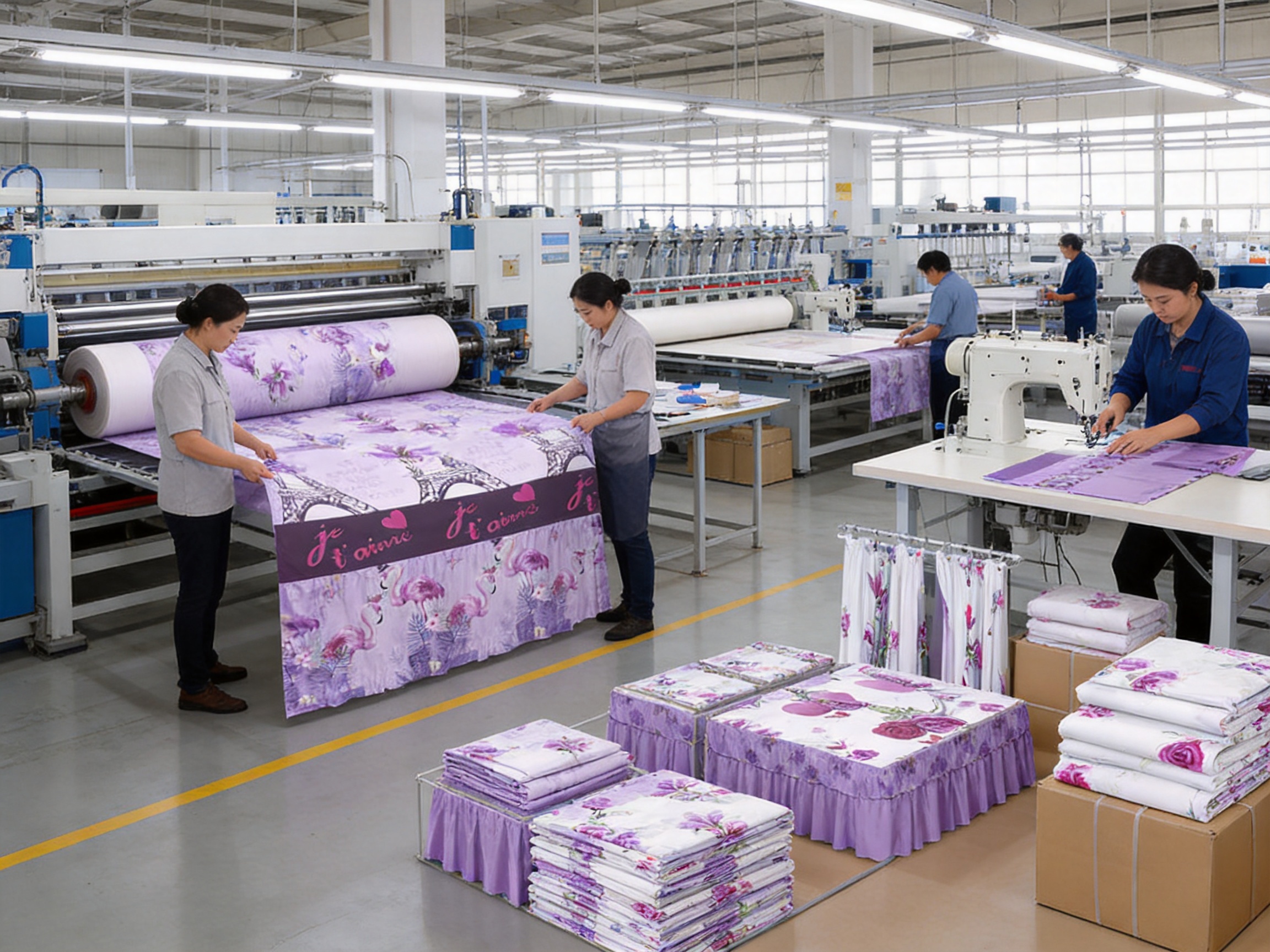
The company operates a factory covering more than 10,000 square meters and employs more than 100 people. This scale provides a foundation for organized production, coordinated quality management, and the handling of different home textile categories. A factory of this type can support several stages of the product process, from material preparation and pattern development through cutting, sewing, inspection, packaging, and export coordination.
Intelligent production equipment is used within the factory. In practical manufacturing terms, intelligent or modernized equipment can support improved cutting accuracy, stable sewing performance, repeatable processing, and more efficient production planning. Such equipment is especially valuable for coordinated sets because several different components must be produced in compatible sizes and styles.
Research and development capabilities also support product improvement. Home textile buyers increasingly expect more than basic fabric and stitching. They look for attractive patterns, useful dimensions, comfortable hand feel, practical construction, and packaging suitable for modern retail. A company that combines product development with factory production can respond more directly to these requirements.
The integration of production and trade functions provides another advantage. Customers do not need to communicate with one organization for manufacturing and a separate organization for export support. The same enterprise can coordinate product specifications, production arrangements, inspection procedures, documentation, and shipment preparation. This may help reduce communication gaps and improve order management.
Production Process
A coordinated six-piece set typically begins with product planning and specification confirmation. At this stage, the intended bed sizes, component dimensions, fabric composition, printed design, curtain structure, labels, packaging, and order quantity are reviewed. Accurate specification confirmation is essential because a bedding set contains components with different functions and measurements.
The next stage involves material preparation. Polyester fabric is selected and prepared for printing, cutting, and sewing. The material must be checked for width, surface condition, color consistency, and suitability for the intended finished products. When the same fabric or related printed material is used across the bed sheet, bed skirt, pillowcases, and curtains, consistency checks become particularly important.
Printing follows the approved design and color requirements. Pattern alignment, color density, registration, and repeat consistency are important considerations. A high-quality printed design should appear visually balanced across the different pieces. The pattern should also support the intended retail presentation, whether the set is displayed folded, packaged, or photographed on a made bed.
After printing and preparation, the fabric is cut according to the specified Queen or King dimensions. Cutting accuracy helps maintain the relationship among the bed sheet, skirt, pillowcases, and curtains. It also helps control fabric waste and supports more efficient production planning.
Sewing and assembly bring the components into their final forms. The bed skirt requires its particular structure and drop measurements. Pillowcases are assembled according to their specified size and construction. Curtain panels are finished to hang evenly, while the bed sheet receives edge treatment appropriate to its use. Throughout these operations, seam strength, edge appearance, and dimensional accuracy are important quality factors.
Inspection is performed to identify issues such as fabric defects, print irregularities, incorrect measurements, loose threads, uneven seams, or missing components. Because the product is sold as a set, packing control is also essential. Each package should contain one bed sheet, one bed skirt, two pillowcases, and two curtain panels corresponding to the correct size and design.
Final packaging protects the textile items during storage and transportation. It also supports retail presentation. Clear product identification, size information, composition details, and care guidance can help buyers understand the product before purchase. For private-label or customized orders, packaging and labeling can be discussed as part of the broader OEM service.
Advantages Over Conventional Competitor Products
The first competitive advantage is the complete coordinated configuration. Many bedding products include only a sheet and pillowcases, requiring customers to purchase curtains separately. Other products may sell curtains and bedding in unrelated patterns. This six-piece collection addresses both needs within one product concept, creating a stronger visual and commercial proposition.
The second advantage is the combination of decorative design and everyday functionality. The printed bedding provides color and style, while the double-layer curtains help manage light and privacy. The product therefore serves both aesthetic and practical purposes. Customers do not have to choose between a decorative bedroom set and a useful window treatment.
The third advantage is material versatility. The 100% polyester microfiber fabric is positioned as soft, breathable, skin-friendly, and suitable for all seasons. Compared with low-quality materials that may feel coarse, lose shape, or show uneven color after limited use, a carefully manufactured polyester textile can offer a more dependable balance of comfort and durability.
The fourth advantage is manufacturing consistency. The set is produced by a company with its own factory, modern equipment, research and development capability, and experience across multiple home textile categories. This production background can support more stable quality than purely trading-based sourcing arrangements in which design, material selection, sewing, and export coordination are split among unrelated parties.
The fifth advantage is customization potential. The company provides customized home textile services based on customer samples. This is important for distributors, retailers, hospitality companies, and private-label brands that require adjustments to colors, patterns, labels, packaging, or dimensions. A product concept with a developed manufacturing foundation can often be adapted more efficiently than a product that exists only as a fixed stock item.
The sixth advantage is category breadth. Since the manufacturer produces bed sheets, quilt covers, pillowcases, cushions, quilts, mattress protectors, curtains, and bedding sets, buyers may be able to develop a broader coordinated home textile collection through one supplier. This can simplify sourcing and help maintain consistency across multiple product lines.
The seventh advantage is export experience. The company states that its products are exported and that it maintains an experienced foreign trade service team. International buyers typically need support with specifications, order communication, production updates, packaging requirements, and shipping documentation. A dedicated foreign trade structure can help make these processes more manageable.
Applications in Residential and Commercial Interiors
In private homes, the set can be used in master bedrooms, guest bedrooms, children’s rooms, vacation homes, and secondary residences. Its coordinated appearance is useful for homeowners who want a quick room refresh without selecting each textile individually. The Queen and King options allow the collection to serve common bed sizes while preserving the same design concept.
Guest rooms can benefit from the complete visual arrangement. Visitors often notice whether a room feels organized and welcoming. Matching curtains and bedding can produce a more intentional appearance with relatively little installation effort. For guesthouse operators and short-term rental owners, coordinated sets can also make room styling more repeatable across multiple spaces.
Hotels, serviced apartments, and other hospitality environments may use coordinated textile concepts to support a consistent interior identity. Commercial buyers must evaluate their own performance, laundering, fire-safety, replacement, and regulatory requirements, but the product’s complete configuration can be useful for rooms where decorative coordination is a priority.
Interior designers can use the set as a base layer for bedroom schemes. The printed pattern can establish the main color direction, while neutral furniture, rugs, lighting, and wall finishes can be selected around it. Designers may also discuss customized patterns or dimensions when a project requires a more specific visual identity.
Retailers can position the product for seasonal promotions, bedroom renovation campaigns, wedding and housewarming gift collections, or value-oriented complete-room packages. The product is especially suitable for displays that show the bed and window together, allowing consumers to understand the full visual effect.
Wholesale, OEM, and Private-Label Potential
For wholesale buyers, the product combines several saleable categories in one package. Instead of ordering bedding and curtains as separate lines, a buyer can offer a six-piece bedroom set with a clear product story. This can simplify inventory planning and create opportunities for bundled pricing, room-set promotions, and coordinated merchandising.
OEM customers may use the existing product structure as a starting point for their own collections. Possible discussion areas can include printed pattern selection, color direction, brand labels, packaging format, size specifications, and order quantities. The final feasibility of any adjustment depends on production requirements, available materials, sampling, and confirmed commercial terms.
Private-label buyers should pay particular attention to packaging and product information. The package can communicate the set contents, material composition, size, care instructions, and brand identity. Accurate information reduces customer confusion and supports more professional retail presentation.
For international distribution, buyers should confirm destination-market requirements before production. These may include textile labeling, fiber-content declarations, packaging language, product safety standards, customs documentation, and any special requirements for curtains or bedding. The manufacturer’s experienced foreign trade team can assist with commercial communication, while buyers remain responsible for confirming the regulations applicable to their markets.
Sampling is recommended before a large order. A sample allows the buyer to evaluate fabric softness, print appearance, curtain layering, seam quality, dimensions, packaging, and overall coordination. It also creates a reference for production approval and helps prevent misunderstandings regarding colors or construction.
Care, Maintenance, and Product Longevity
Proper care is essential for preserving the appearance and performance of any bedding and curtain set. Buyers should follow the final care label and supplier instructions because washing temperature, drying method, detergent type, and ironing conditions can affect printed polyester fabrics. Correct care can help reduce unnecessary wear and maintain the visual quality of the set.
Bedding should be washed according to its care instructions and should not be overloaded in the washing machine. Adequate space allows water and detergent to move through the fabric more effectively. Separating strong colors from light-colored textiles during the first wash and when necessary afterward can help reduce the possibility of unwanted color transfer.
Direct and prolonged exposure to intense sunlight may affect any printed textile over time. Although the product is designed with long-lasting color performance in mind, curtains can be exposed to more sunlight than bedding. Using appropriate window positioning, rotating panels when practical, and following recommended care procedures can help support a longer attractive service life.
Before storage, all pieces should be clean and fully dry. The bedding and curtains should be folded without excessive compression and stored in a dry, ventilated location. Avoiding moisture and harsh chemical contact is particularly important for maintaining fabric hand feel and print appearance.
Retailers and hospitality operators should establish a consistent textile-care process. Staff should know which detergents and cycles are suitable, how to inspect seams and edges, and when to remove a piece from service. Consistent care can improve the useful life of the collection and help ensure that replacement pieces maintain a similar appearance.
Quality Evaluation for Buyers
When evaluating this six-piece set, buyers should inspect both individual components and the relationship among them. The fabric should feel consistent across the bed sheet, bed skirt, pillowcases, and curtains. The printed pattern should be clear, evenly applied, and free from obvious defects. Colors should appear compatible across the complete set.
Dimensions should be measured against the approved specification. The bed sheet should correspond to the selected Queen or King size, while the bed skirt should provide the expected coverage and drop. Pillowcases should match the stated dimensions, and the two curtain panels should be sufficiently consistent to hang as a balanced pair.
Seams should be straight and secure, with neat finishing and no excessive loose threads. Corners and edges deserve special attention because they experience repeated handling. The curtain construction should be checked for evenness, and the double-layer structure should be clearly present and properly assembled.
Packaging inspection should confirm that all six pieces are included and that the size identification is correct. For wholesale shipments, random carton inspection and agreed quality-control procedures can help identify packing errors before goods reach the final customer.
Buyers should also compare the complete value rather than judging price alone. A low-cost bedding-only set may appear less expensive at first, but the purchaser may still need to buy separate curtains, additional pillowcases, or a bed skirt. The six-piece format can reduce the total sourcing burden and deliver a more complete room solution.
Why Factory Integration Matters
Factory integration affects more than production capacity. It creates a closer connection among design, materials, manufacturing, quality control, and customer service. When product development and production occur within the same enterprise, feedback from customers can be incorporated more directly into future designs and specifications.
For a coordinated set, this connection is especially valuable. The bedding and curtains must share a visual identity, but they also require different construction methods. The bed sheet must be comfortable and appropriately finished for sleeping. The bed skirt must cover the bed neatly. Pillowcases must be practical and attractive. Curtains must hang properly and provide the intended layered effect. An integrated manufacturing system can coordinate these different requirements more effectively.
The company’s broad home textile portfolio also supports technical experience across related products. Knowledge gained from producing waterproof mattress protectors, quilts, cushions, pillowcases, and curtains can contribute to a more comprehensive understanding of household textile performance. This multi-category experience is useful when developing complete room collections.
The factory’s size, workforce, intelligent equipment, and standardized management system provide a foundation for repeatable output. No manufacturing system eliminates the need for inspection and communication, but organized production can reduce variability and improve the ability to respond to regular orders, customized projects, and export requirements.
Q&A
What is included in the six-piece set?
The set includes one bed sheet, one bed skirt, two pillowcases, and two curtain panels. Together, these six pieces create a coordinated bedroom textile arrangement.
What material is used?
The product is made from 100% polyester, described as microfiber polyester in the product information. The fabric is intended to provide a soft, delicate, skin-friendly, and breathable feel.
Which bed sizes are available?
The stated configurations are Queen and King. The Queen bed sheet measures 210 × 230 centimeters, while the King bed sheet measures 235 × 270 centimeters. Buyers should confirm the desired size and compare the measurements with their local mattress and bed-frame standards.
What are the curtain dimensions?
Each curtain panel measures 120 × 220 centimeters. Two panels are included in each set, and the curtains are designed as a double-layered window treatment.
Are the curtains only decorative?
No. The double-layer design is intended to combine decorative styling with light-management and privacy-related functions. Actual light reduction depends on the room, window, installation, fabric conditions, and surrounding environment.
Is the set suitable for all seasons?
The product is described as suitable for all seasons. It can be used as a coordinated bed covering and window treatment throughout the year, with additional quilts, blankets, or comforters added according to climate and personal preference.
What makes the set different from a standard bedding set?
A standard bedding set may include only sheets and pillowcases. This product also includes a bed skirt and two matching curtains, allowing the bed and window areas to share one coordinated design.
Can the product be customized?
The manufacturer provides customized home textile services based on customer samples. Buyers can discuss potential requirements such as patterns, colors, dimensions, labels, packaging, and private-label arrangements. Customization should be confirmed through sampling and formal production specifications.
What should buyers check before placing a wholesale order?
Buyers should confirm the fabric composition, size configuration, printed pattern, curtain construction, color standard, packaging, labeling, order quantity, delivery schedule, and destination-market requirements. A pre-production sample and an approved quality reference are recommended for larger orders.
Where is the product manufactured?
The product is manufactured by Dongyangshi Menghui Textile Co., Ltd., a home textile enterprise based in Dongyang City, Zhejiang Province, China. The company integrates research and development, production, sales, and export services.
What company capabilities support this product?
The company operates a factory of more than 10,000 square meters, employs more than 100 people, uses intelligent production equipment, maintains a standardized management system, and has an experienced foreign trade service team. It also produces a broad range of bedding and household textile products.
Conclusion
The printed six-piece bedspread set with double-layer curtains is designed as a complete and coordinated bedroom furnishing solution. Its combination of a bed sheet, bed skirt, pillowcases, and matching curtains provides more than basic sleeping textiles. It creates a unified visual environment while adding practical value through layered window treatment, soft polyester microfiber fabric, all-season usability, and organized construction.
Its advantages over conventional competitor products include integrated design, complete room coverage, coordinated printing, double-layer curtain functionality, flexible Queen and King sizing, and potential customization for wholesale and private-label programs. The product is also supported by a manufacturer with factory resources, intelligent equipment, research and development capability, a broad home textile portfolio, and export experience.
For consumers, the set offers a convenient way to refresh a bedroom with a consistent style. For retailers, it provides a clearly defined product package that can be merchandised as a complete room solution. For hospitality and project buyers, it offers a foundation for coordinated bedroom presentation. For OEM customers, it provides a developed product structure that can be adapted to specific market and branding requirements.
With accurate specification confirmation, appropriate quality inspection, and proper textile care, this six-piece collection can serve as a practical, attractive, and commercially versatile addition to a modern home textile range.
References
1. Product specification and component information supplied for the printed six-piece bedspread set with double-layer curtains.
2. Manufacturer information supplied for Dongyangshi Menghui Textile Co., Ltd., including factory capacity, product categories, production equipment, and export services.
3. General textile manufacturing principles concerning polyester microfiber, fabric cutting, printed textile production, sewing, inspection, and packaging.
4. General home furnishing principles concerning coordinated bedding, curtain layering, bedroom styling, light management, and textile maintenance.
5. General wholesale and OEM sourcing practices for home textile products, including sampling, quality approval, labeling, packaging, and market compliance review.
Product: Printed 6-Piece Bedspread Set With Double-Layer Curtains


Contact Us for More Details
Don't hesitate to contact when you need us!
Contact Information
Add:
Building 1, East Area, Wanyang Zhongchuang City, Economic Development Zone, Dongyang City, Zhejiang Province, China
Phone:
Tel:
E-mail:
Quick Links
Product Category
QR Code


+86-13616899966
+86-579-86610966
