 English
 русский
 Español
 عربى
عربى

Gold Quilted Bedspread Brings Color Into Bedding Design
Color and surface texture are increasingly being considered together in bedding development. A Gold Quilted Bedspread illustrates this approach by combining a warm metallic-inspired tone with a structured quilted surface. Rather than treating color as a separate decorative decision, bedding designers can use the relationship between fabric, quilting pattern, surface sheen, and overall bed coverage to create a more coordinated visual effect. This is particularly relevant for hospitality projects, home textile collections, and private-label bedding ranges where appearance needs to work alongside practical construction.
Quilting Does More Than Create a Pattern
The defining characteristic of a quilted bedspread is the way its layers are joined. Quilting can hold a face fabric, filling, and backing together while also creating a visible pattern across the surface. The stitch arrangement can affect how the textile folds, drapes, and maintains its shape during use. Industry bedding specifications commonly consider stitch patterns, filling weight, lining, hems, corners, and pillow-tuck dimensions as interconnected construction details rather than independent decorative features.
For a Gold Quilted Bedspread, this relationship becomes especially noticeable because the gold tone can interact with raised or recessed quilting lines. A geometric pattern may create a more structured appearance, while curved or floral quilting can produce a softer visual character. The quilting therefore becomes part of the color presentation, since changes in surface direction can alter how light reflects from the fabric.
Surface Texture Influences the Appearance of Gold
Gold is not simply a single visual effect in textile design. Depending on the fabric construction and finish, a warm gold shade can appear subtle, muted, reflective, or more decorative. Quilting introduces another variable by breaking a flat textile surface into smaller sections.
This makes fabric selection important when developing a Gold Quilted Bedspread. A smoother face fabric may emphasize the uniformity of the color, while a textured textile can produce more variation across the quilted areas. The relationship between fabric weave and quilting pattern can consequently affect whether the finished product feels traditional, contemporary, formal, or relaxed.
Recent bedding discussions also show continued interest in textured surfaces, with quilted and matelassé constructions being used to introduce dimensional character without relying entirely on prints or elaborate decoration.
Quilting Density Affects Drape and Structure
The distance between quilting lines is another practical design consideration. Stitching that is too widely spaced can allow filling to move more freely, while denser quilting can create a firmer and more structured surface. The selected pattern also influences how the finished bedspread bends around mattress edges and falls toward the sides of the bed.
For buyers developing a Gold Quilted Bedspread collection, quilting density should therefore be considered alongside the intended weight and visual effect. A lightweight bedspread may require a different construction approach from a heavier decorative covering. Commercial bedding specifications, for example, can use different filling weights according to the intended application.
The same consideration applies to the edge. Borders, hems, piping, and corner construction receive repeated mechanical stress during handling and laundering, so their relationship with the quilting pattern can influence the finished appearance.
Bed Size Changes the Design Proportion
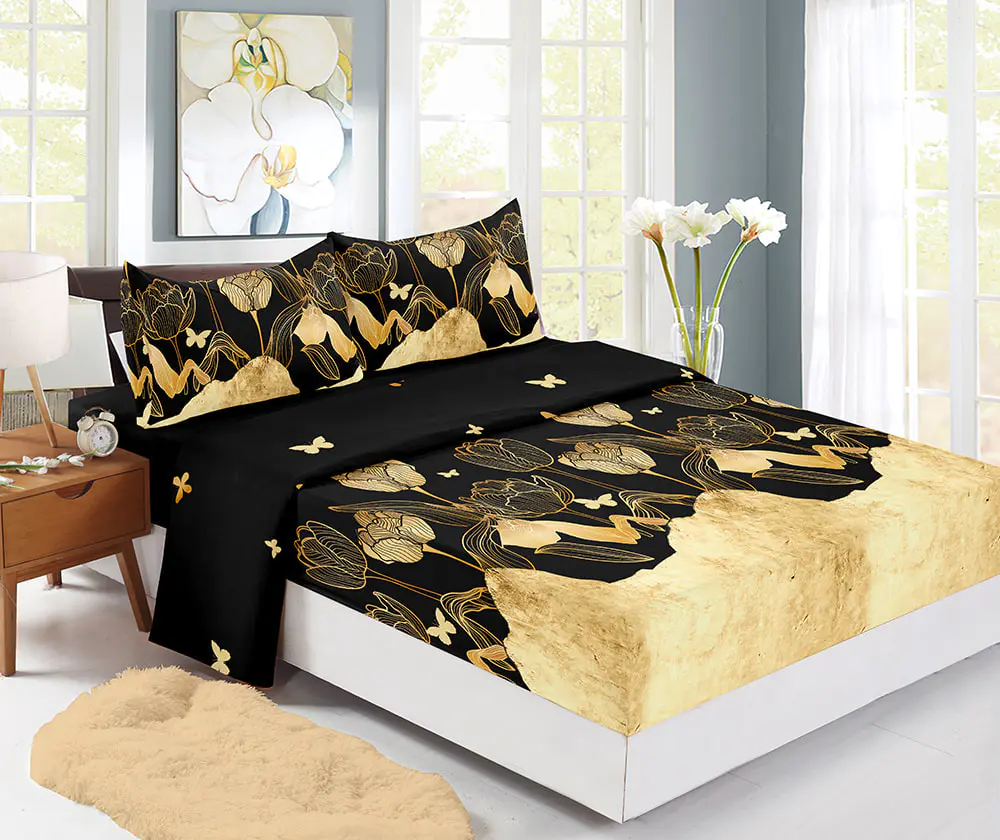
A bedspread is not simply a smaller textile enlarged to fit different mattresses. Its dimensions determine how the quilting pattern is distributed across the visible surface. A motif that looks balanced on a smaller bed may appear too concentrated or too widely spaced when scaled to a larger size.
The required drop is also important. Bedding specifications often distinguish the mattress, box spring, and complete bed dimensions when determining the finished size because mattress thickness and bed construction can vary.
For a Gold Quilted Bedspread, proportional planning can be particularly useful because the combination of color and quilting makes inconsistencies more visible. Designers may need to consider where the central pattern finishes, how the border aligns with the sides, and whether the quilting remains visually balanced when the fabric extends over the edge of the bed.
Color Coordination Extends Beyond the Bedspread
Gold-toned bedding can also influence how the rest of a bedroom collection is developed. Instead of matching every textile to the same shade, designers can use gold as an accent against neutral, cream, beige, gray, or deeper tones. The quilted surface then provides texture while the color establishes a visual focal point.
This approach creates opportunities for coordinated products such as pillow shams, cushions, runners, and other bedroom textiles. Custom bedding manufacturers already use variations in quilting patterns, batting, borders, and edge treatments to create coordinated collections.
For a Gold Quilted Bedspread, this means the product can be considered as part of a broader textile range rather than an isolated bedding item. Private-label developers may evaluate the color palette, quilting motif, fabric hand feel, finished dimensions, and complementary accessories together.
Manufacturing Choices Shape the Finished Appearance
From a production perspective, quilting requires coordination between fabric tension, filling distribution, stitching, cutting, and finishing. Pattern alignment can become especially relevant when the same motif continues across the center, border, and side sections.
A Gold Quilted Bedspread therefore requires more than selecting an attractive color. The final appearance results from several manufacturing decisions working together. Fabric behavior during quilting, the selected filling, stitch configuration, edge treatment, and dimensional control all contribute to how the finished textile looks on a bed.
As bedding collections continue to place greater emphasis on tactile surfaces and coordinated color systems, quilted construction remains a useful way to combine visual structure with practical textile assembly. The development of the Gold Quilted Bedspread reflects this broader direction: color establishes the visual identity, while quilting provides the dimensional structure that allows the textile to function as both a bed covering and an important element of bedroom design.


Contact Us for More Details
Don't hesitate to contact when you need us!
Contact Information
Add:
Building 1, East Area, Wanyang Zhongchuang City, Economic Development Zone, Dongyang City, Zhejiang Province, China
Phone:
Tel:
E-mail:
Quick Links
Product Category
QR Code



+86-13616899966
+86-579-86610966
