 English
 русский
 Español
 عربى


Printed Six-Piece Bedspread Set with Double-Layer Curtains: A Practical Guide to Coordinated Bedroom Textiles
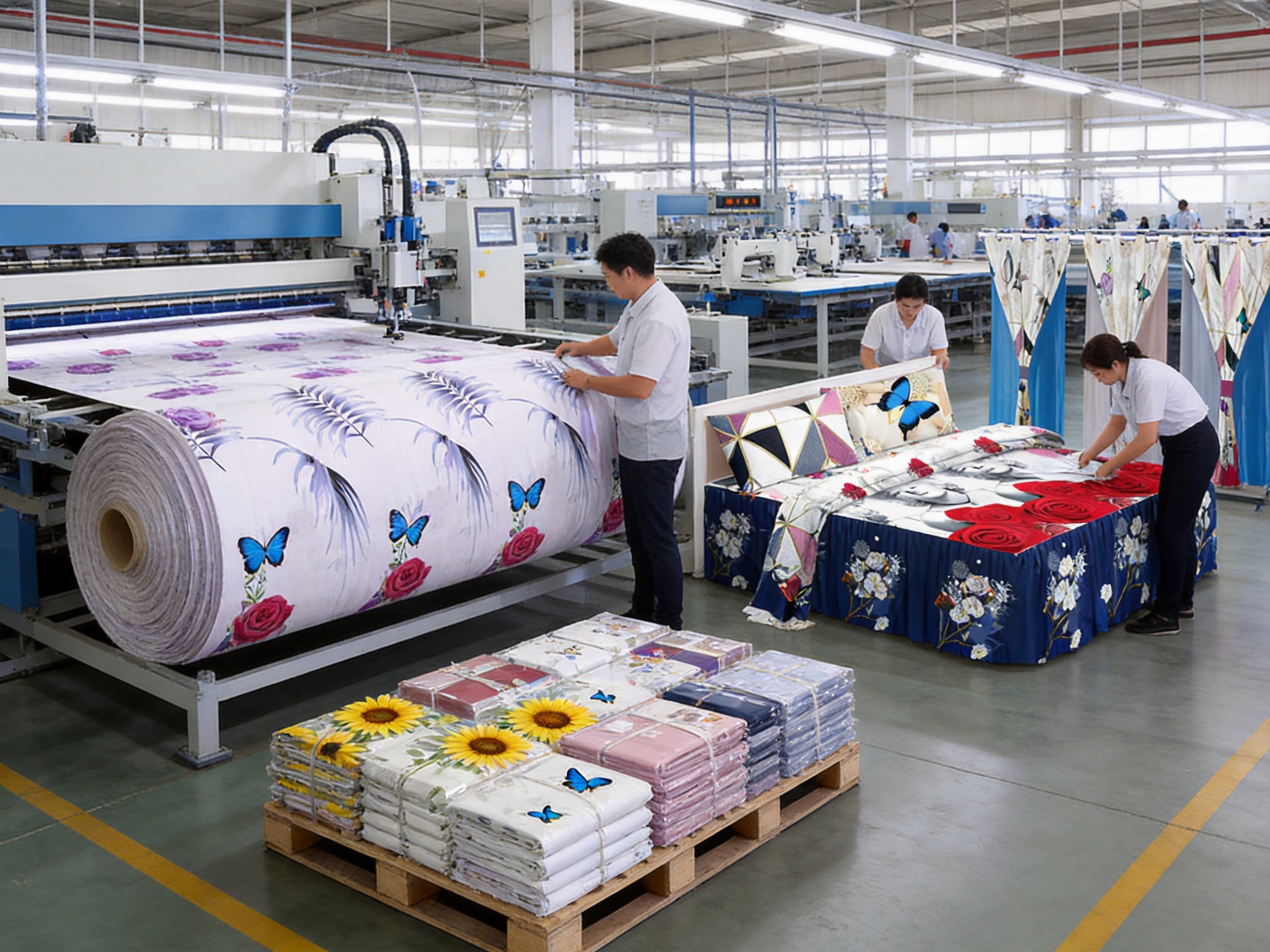
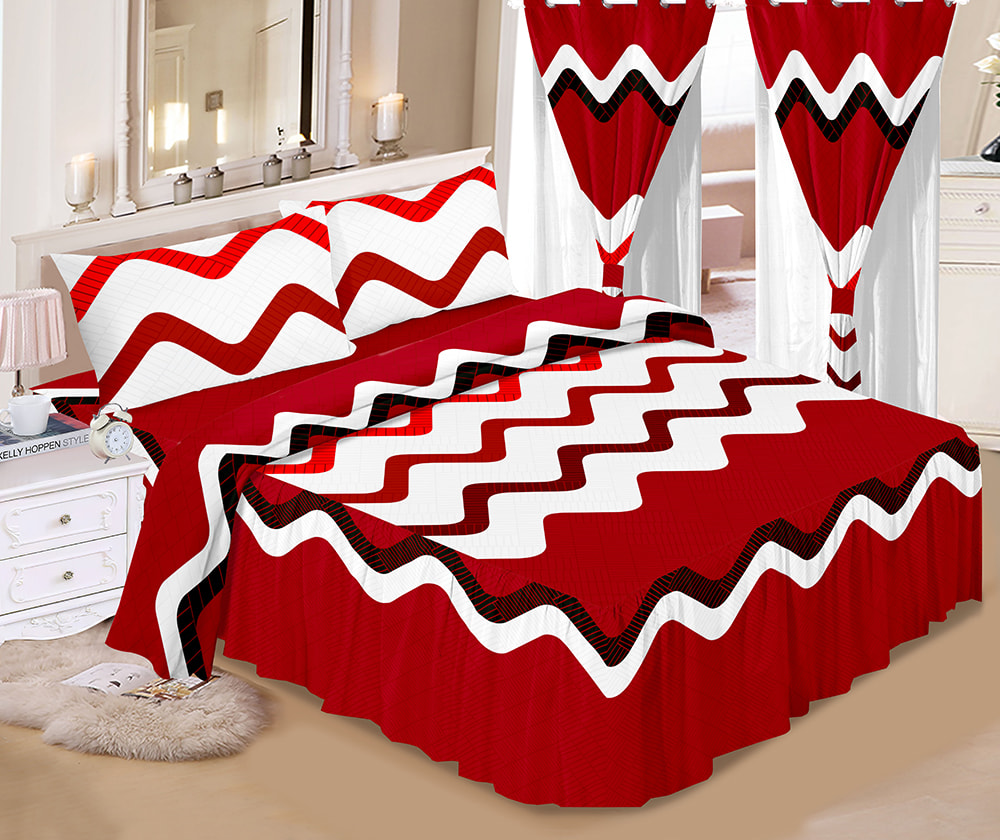
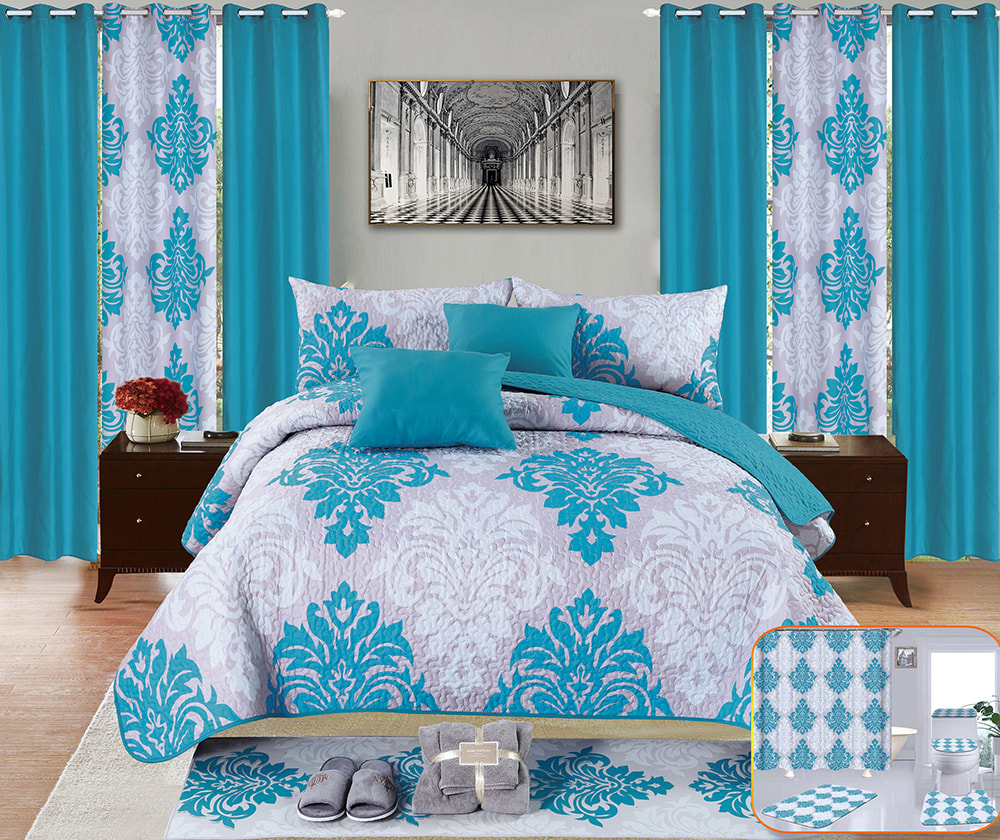
A well-designed bedroom depends on more than a comfortable mattress. The visual relationship between the bed, windows, walls, and soft furnishings determines whether the room feels unfinished, overly busy, or genuinely coordinated. A printed six-piece bedspread set with double-layer curtains addresses these needs in one integrated textile package. Instead of purchasing a bed covering, pillowcases, and curtains separately, buyers receive a coordinated collection designed around the same print, color palette, and general decorative direction.
This type of set is particularly useful for homeowners, hospitality operators, interior retailers, property developers, and importers seeking an efficient way to create a unified bedroom appearance. It combines a bed sheet, a bed skirt, two pillowcases, and two curtains. The queen-size and king-size options provide different bed-covering dimensions, while the curtains use a consistent size in the supplied specification. The result is a practical home textile solution that brings together decorative design, everyday functionality, and efficient purchasing.
The product is manufactured from 100% polyester, described in the supplied information as microfiber polyester. This material offers a soft hand feel, easy care, color-rich printing, and useful durability for regular household use. The bed textiles and curtains are printed with matching patterns, allowing the set to function as a complete room styling system rather than a collection of unrelated pieces.

Printed 6-Piece Bedspread Set With Double-Layer Curtains
Understanding the Six-Piece Composition
The name “six-piece set” refers to the total number of individual textile pieces included. The standard configuration consists of one bed sheet, one bed skirt, two pillowcases, and two curtains. While the product is presented as a printed bedspread set with curtains, its detailed dimensions identify the primary bed covering as a bed sheet and the lower decorative component as a bed skirt. Buyers should therefore review the exact configuration when comparing it with traditional comforter sets, quilt sets, or duvet-cover packages.
| Included Piece | Quantity | Primary Function |
|---|---|---|
| Bed sheet | 1 piece | Provides the main printed surface for the bed |
| Bed skirt | 1 piece | Complements the bed, covers the lower frame area, and adds a decorative finish |
| Pillowcase | 2 pieces | Coordinates the pillows with the bed textiles |
| Double-layer curtain | 2 pieces | Combines window decoration with light management |
The composition is valuable because it reduces the visual mismatch that often occurs when bed linens and window treatments are purchased from different collections. A bed may have one pattern, the curtains another color, and the pillowcases a third texture. In contrast, this set is built around a unified print concept. That consistency can make a room appear more carefully designed without requiring extensive interior decorating knowledge.
The set also offers purchasing efficiency. Retailers can present a complete bedroom solution in one product listing, while wholesalers can simplify inventory planning by managing one coordinated style rather than several independent items. For consumers, the package reduces the time spent searching for matching pieces and can make a guest room, rental property, or newly furnished home look complete soon after installation.
Material Characteristics and Everyday Comfort
The supplied product information identifies the fabric as 100% polyester, with the product title describing it as microfiber polyester. Polyester is widely used in modern bedding and curtain production because it combines flexibility, resistance to ordinary household wear, and relatively easy maintenance. Microfiber construction can provide a smoother and more delicate surface compared with many conventional woven polyester fabrics, helping the textile feel soft against the skin.
Softness is an important consideration for bedding because the sheet and pillowcases come into direct contact with the user. A fabric that feels smooth and comfortable can improve the perceived quality of the entire set. The product description emphasizes a soft, delicate, skin-friendly, and breathable feel. Although comfort depends on individual preference, room temperature, and bedding layers, the lightweight textile construction is suitable for use across different seasons when paired with appropriate blankets or quilts.
Polyester also supports practical household use. It generally dries more quickly than heavier natural-fiber fabrics and can be easier to handle during routine washing. This is useful for family bedrooms, guest rooms, serviced apartments, hotels, and other environments where bedding may need frequent laundering. The fabric’s stability also helps the printed pieces retain their shape when properly washed and dried according to care instructions.
Another important material benefit is its suitability for printed decoration. Polyester fibers can support vivid color application, allowing manufacturers to produce floral, geometric, abstract, traditional, or contemporary patterns with strong visual impact. The supplied description highlights rich and long-lasting colors that resist fading. Color performance depends on the printing method, dye fixation, washing conditions, and exposure to sunlight, but a properly produced polyester print can maintain a consistent appearance through normal use.
It is important to distinguish “breathable” from “cooling.” A textile may permit comfortable air movement and manage moisture reasonably well, but it does not automatically provide the same sensation as a lightweight natural fiber or specialized cooling fabric. The practical advantage of this set is its balanced combination of softness, decorative printing, manageable care, and broad seasonal usability.
Coordinated Printing as a Design Advantage
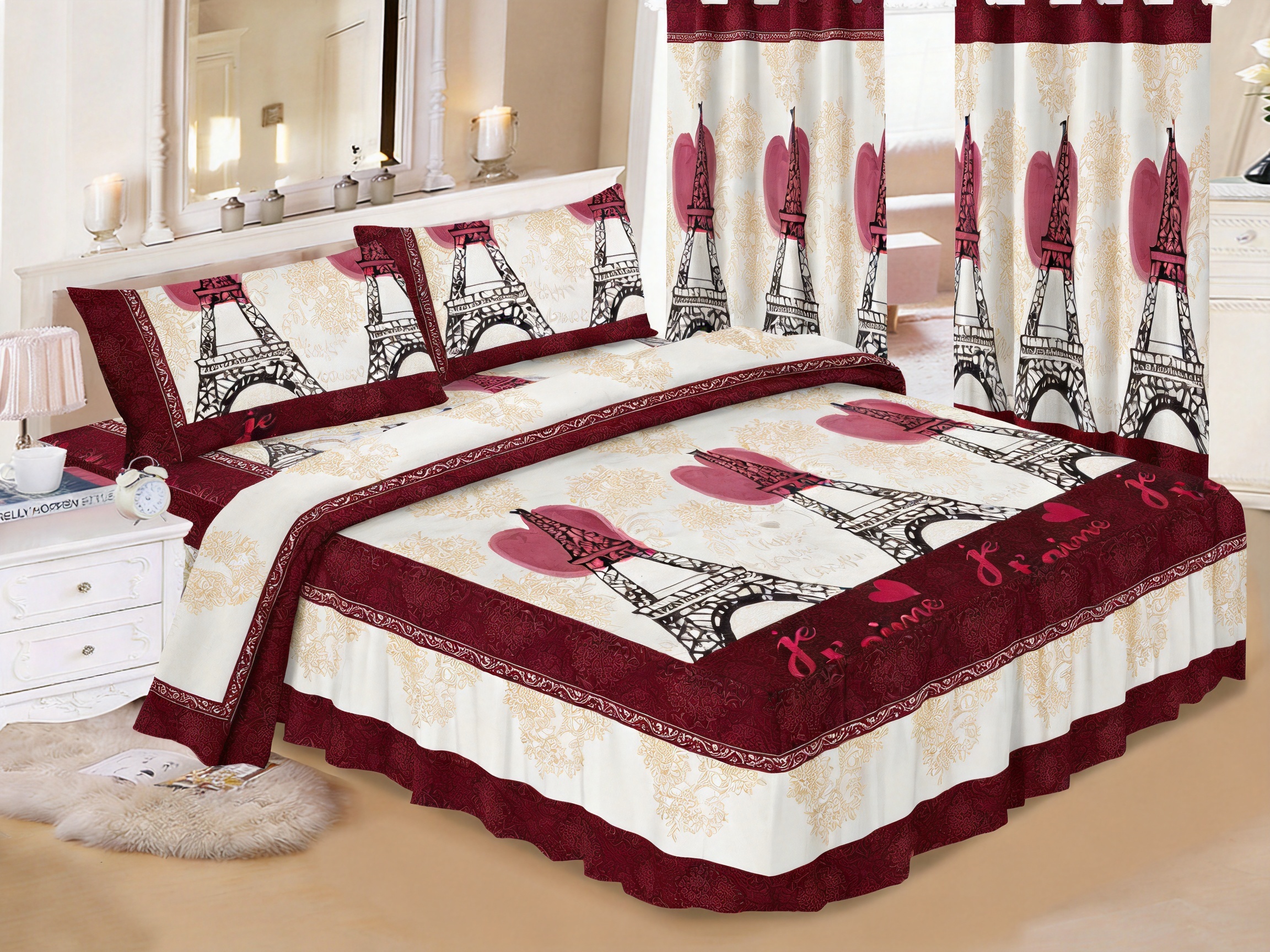
The principal visual strength of this product is the matching pattern across the bed sheet, bed skirt, pillowcases, and curtains. Coordinated printing creates continuity from the center of the room to the windows. This is especially useful where the bedroom has limited decorative elements, because the textile package can act as the room’s primary design feature.
Many competing bedding products focus only on the bed. Their colors may coordinate with one another, but the curtains must be sourced separately. This creates several potential problems: a slight difference in shade, an unavailable matching design, inconsistent fabric texture, or a curtain length that does not suit the room. The six-piece set reduces these risks by delivering the main textile elements together.
A unified pattern can also make a bedroom feel more spacious and intentional. Repetition of color and motif guides the eye around the room instead of creating isolated visual points. For smaller bedrooms, a carefully selected print can create a finished appearance without requiring many additional accessories. For larger rooms, the curtains help distribute the bedding design across the space so the bed does not appear visually disconnected from the window area.
Retailers can offer the product in different style directions depending on the available print collection. Rich patterns may suit customers who want a traditional or luxurious atmosphere, while restrained geometric or botanical designs may appeal to modern interiors. Because the underlying product structure remains consistent, a manufacturer can support a broad design catalog while preserving efficient production and packaging procedures.
Color Retention and Visual Consistency
Color retention is one of the most important quality factors in printed home textiles. A set may have an attractive pattern at the time of purchase, but poor color fixation can reduce its value after laundering or prolonged exposure to daylight. A reliable manufacturing process therefore needs to control the printing, drying, curing, and inspection stages carefully.
Consistent color is equally important between individual pieces. If the pillowcases are noticeably darker than the bed sheet, or the curtains have a different tone from the bed skirt, the coordinated concept is weakened. Production planning should keep matching pieces within the same color standard and verify the print before cutting and sewing. This is one area where organized factory management can provide an advantage over fragmented sourcing.
Double-Layer Curtains and Functional Window Styling
The double-layer curtain design gives the set a wider functional range than a bedding-only package. Curtains are not merely decorative panels. They influence privacy, glare, visual comfort, and the amount of daylight entering the room. A double-layer construction can combine a decorative outer surface with an additional layer that supports light control or privacy.
The product description explains that the double-layer structure combines light-blocking and decorative functions. In practical use, the degree of light reduction will depend on the fabric density, lining structure, color, window size, installation method, and the amount of daylight outside. It is therefore more accurate to describe the curtains as helping regulate indoor light rather than promising complete blackout in every environment.
When closed, the curtains can reduce direct brightness and help create a calmer sleeping environment. This may be beneficial in bedrooms facing busy streets, brightly lit buildings, or early morning sunlight. During the daytime, users can open the panels to restore natural light. The ability to adjust the room atmosphere without changing the bedding makes the curtains a valuable part of the set rather than an accessory added only for appearance.
The matching print also helps the curtains frame the bed visually. A coordinated window treatment can make the room appear professionally decorated, which is especially useful in rental properties, model rooms, guesthouses, and hospitality settings. Instead of selecting separate curtains that may compete with the bed covering, the buyer receives a balanced design from one collection.
The specified curtain size is 120 by 220 centimeters for each of the two pieces. Buyers should compare this measurement with the width and height of their windows, the desired fullness, the mounting method, and the curtain rod position. A pair of panels may be suitable for a standard window, but larger windows or sliding doors may require additional panels or a different sizing arrangement.
Available Sizes and Dimensional Planning
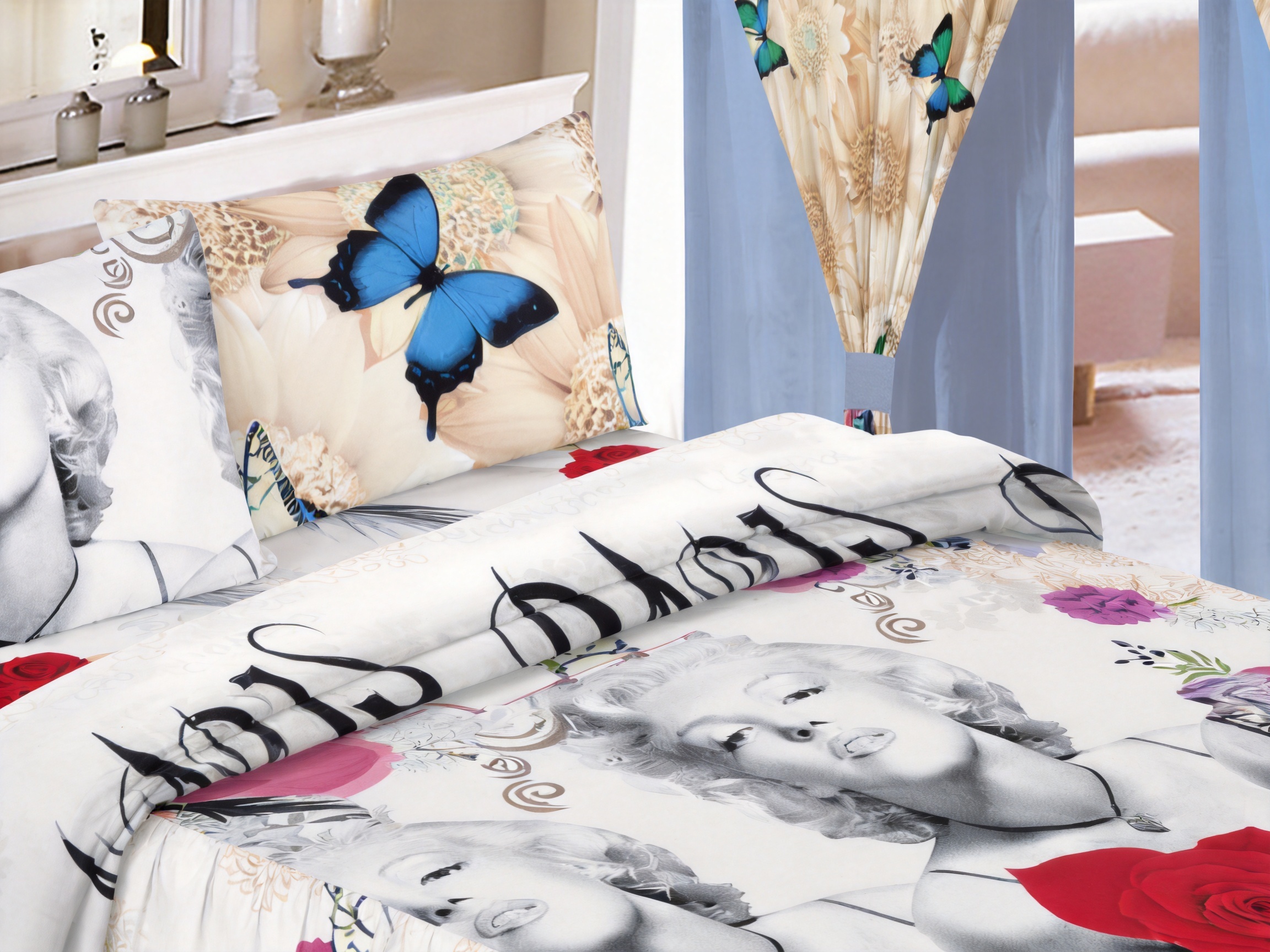
The set is supplied in queen-size and king-size configurations. Accurate dimensional planning is essential because bed frames, mattresses, and regional size standards can vary. The product dimensions should be treated as the reference point for purchasing decisions rather than relying only on the labels “queen” or “king.”
| Size | Bed Sheet | Bed Skirt | Pillowcases | Curtains |
|---|---|---|---|---|
| Queen | 210 × 230 cm, 1 piece | 152 × 198 + 30 + 40 cm, 1 piece | 50 × 70 cm, 2 pieces | 120 × 220 cm, 2 pieces |
| King | 235 × 270 cm, 1 piece | 198 × 203 + 30 + 40 cm, 1 piece | 50 × 100 cm, 2 pieces | 120 × 220 cm, 2 pieces |
The notation for the bed skirt includes several measurements. The principal dimensions identify the main bed area, while the additional figures indicate the drop or structural portions of the skirt. Because bed frames differ in height, buyers should measure the mattress and the distance from the top of the bed structure to the desired lower edge before ordering large quantities.
The queen-size bed sheet measures 210 by 230 centimeters, while the king-size sheet measures 235 by 270 centimeters. These measurements provide the principal coverage dimensions, but the final appearance also depends on mattress thickness, tuck-in depth, bed frame design, and whether the sheet is intended to lie flat or provide additional side coverage.
The pillowcase dimensions also differ by size. Queen pillowcases measure 50 by 70 centimeters, while king pillowcases measure 50 by 100 centimeters. Pillow fill level can affect how these covers look after insertion. Buyers purchasing for retail should display the pillowcase measurements clearly so customers can select the correct option for their pillows.
The curtains remain listed at 120 by 220 centimeters per panel for both bed sizes. This means the bedding size and window treatment size are not directly connected. A king-size bedding package does not automatically indicate larger curtains. Retailers should communicate this distinction clearly and encourage customers to measure their windows before purchase.
Advantages Compared with Separate Textile Purchasing
One of the strongest competitive advantages of a complete coordinated set is convenience. Buying separate bedding, pillowcases, and curtains requires multiple product searches, additional decisions, and careful comparison of color and fabric. A six-piece package streamlines the process and presents a complete solution at the point of purchase.
There can also be economic benefits. Manufacturing several related pieces in one coordinated production plan may reduce repeated material handling, design preparation, packaging work, and procurement complexity. Those efficiencies can support competitive pricing, although actual pricing will depend on order quantity, print complexity, fabric weight, packaging, customization, and shipping conditions.
Another advantage is visual accuracy. Separate products described as “matching” may use different base fabrics, print scales, or color standards. A coordinated set produced through the same supply chain is more likely to maintain consistency among the pieces. This consistency is particularly important for commercial buyers furnishing multiple rooms.
The product also offers a stronger room transformation than a bed-only set. A new sheet and pillowcases improve the bed, but matching curtains extend the effect to the surrounding architecture. This can produce a more noticeable change with fewer purchases. For seasonal promotions or room refresh projects, the set can be presented as a complete style update.
Compared with a traditional comforter-focused package, this set may be more flexible in warmer environments or for buyers who already own quilts and blankets. The bed sheet and bed skirt establish the decorative foundation, while existing blankets can be layered according to season. This makes the package suitable for homes where users prefer adjustable bedding rather than one thick comforter throughout the year.
Manufacturing Process and Quality Control
The quality of a printed bedding and curtain set depends not only on the fabric but also on the manufacturing sequence. Dongyangshi Menghui Textile Co., Ltd. is described as an industrial and trade enterprise integrating research and development, production, sales, and export. This integrated structure can support closer coordination between product design, factory planning, quality inspection, and customer service.
Product Development and Sample Review
Production begins with product development. A design team or customer may select a print concept, specify the fabric composition, determine the size range, and define the intended market position. For customized orders, the company provides home textile services based on customer samples. This capability is useful for buyers seeking private-label products, retailer-exclusive designs, or adaptations of an existing style.
Before bulk production, sample review helps confirm the print scale, color direction, fabric hand feel, dimensions, sewing details, and overall appearance. A sample can also reveal whether a pattern aligns attractively across the bed sheet, pillowcases, bed skirt, and curtains. This stage is especially important when the design includes directional motifs, borders, large repeats, or multiple color fields.
Fabric Preparation and Printing
The supplied material is 100% polyester microfiber. Fabric preparation may include inspection for surface defects, width consistency, cleanliness, and suitability for printing. The fabric must be properly handled so that the print remains clear and the finished pieces retain a stable appearance after cutting and sewing.
Printing requires attention to color control, pattern registration, repeat accuracy, and penetration or fixation appropriate to the selected process. A high-quality print should show clean details and an even distribution of color. The production team must also verify that the bed sheet and curtain fabric are compatible with the intended double-layer construction.
After printing, drying or curing processes help stabilize the colors. The exact method depends on the printing system and fabric specifications. Proper process control reduces the risk of rubbing, uneven shades, blurred motifs, or excessive color loss during normal care. Samples from production lots can be compared against approved standards before the fabric is released for cutting.
Automated and Intelligent Production Equipment
The company information states that the factory is equipped with intelligent production equipment. Modern equipment can improve cutting accuracy, production repeatability, and workflow efficiency. Computer-assisted cutting systems, organized material handling, and programmable sewing equipment can help reduce variation among individual pieces, particularly in larger orders.
Equipment alone does not guarantee quality. Skilled operators and supervisors remain essential for checking fabric alignment, seam allowance, edge finishing, and pattern placement. The best results come from combining technology with standardized operating procedures and experienced personnel. The company is described as having more than 100 employees and a standardized management system, providing a foundation for coordinated production at commercial scale.
Cutting and Pattern Placement
Cutting is a critical stage because the same printed fabric must be converted into pieces of different shapes and sizes. The bed sheet, bed skirt, pillowcases, and curtains may require different grain directions, panel arrangements, or seam positions. Careful planning helps improve fabric utilization while preserving the intended visual balance.
Pattern placement affects the perceived quality of the finished product. A major motif should not be unintentionally cut through an awkward location, and matching pieces should retain a coherent visual relationship wherever practical. For curtains, the pattern should be oriented correctly when the panels are hung. For pillowcases, the print should appear attractive on the visible surface.
Sewing and Finishing
Fine workmanship and neat stitching are specifically highlighted in the product description. Sewing quality influences durability, comfort, and appearance. Straight seams, secure thread ends, consistent hems, and clean corners help the set withstand repeated handling. The curtain edges should be finished carefully because they may be opened and closed frequently.
The bed skirt requires particular attention because it is exposed to movement around the bed frame. Its construction must support a neat drape and maintain an attractive lower edge. Pillowcases should have openings that allow easy insertion while keeping the pillow securely inside during use. Each component should be checked for loose threads, skipped stitches, fabric snags, and incomplete seams.
Inspection, Packing, and Export Preparation
Inspection may take place at several points: after fabric preparation, after printing, during cutting, during sewing, and before packing. A final inspection should verify the number of pieces, dimensions, print consistency, sewing quality, labeling, and packaging condition. This is particularly important for six-piece sets because a missing pillowcase or curtain panel makes the package incomplete.
As an export-oriented manufacturer, the company’s production and service structure is designed to support international orders. Export preparation may include carton planning, product labeling, packing lists, sample confirmation, and communication with overseas buyers. Reliable documentation reduces confusion during large shipments and supports more consistent receiving procedures for importers and distributors.
Factory Capacity and Business Strengths
The manufacturer is described as operating a factory covering more than 10,000 square meters. A facility of this scale can provide space for fabric storage, production lines, inspection areas, packing operations, sample development, and administrative coordination. Adequate factory space is important for keeping raw materials organized and separating different customer orders or print collections.
The company was founded in 2015 and combines research and development, production, sales, and export. This structure can be advantageous for buyers that need more than a standard catalog product. A customer may require a new print, revised dimensions, private packaging, a different composition, or an adaptation based on a physical sample. Direct access to production and development teams can make those requests easier to evaluate.
The company’s stated product range includes bed sheets, quilt covers, pillowcases, cushions, quilts, waterproof mattress protectors, curtains, and other bedding sets. This broader category coverage gives buyers the opportunity to build a coordinated product line from one supplier. A retailer could develop a bedroom collection that includes the six-piece set alongside mattress protection, duvet covers, quilts, and additional cushion styles.
An experienced foreign trade service team is another stated strength. International textile purchasing requires clear communication about measurements, fabric details, packing, production schedules, inspection, and shipping documentation. A dedicated service team can help reduce misunderstandings between the factory and overseas customers, especially when orders involve multiple sizes or customized packaging.
All products are described as being exported. Export experience does not replace the need for buyer inspection or written specifications, but it indicates familiarity with the practical requirements of serving international markets. For wholesalers and brand owners, this can support a more organized sourcing relationship from sample development through repeat production.
Applications Across Different Markets
For household consumers, the set offers a quick way to refresh a bedroom. It can be used in a primary bedroom, guest room, student accommodation, or vacation property. The curtains make the package more useful than a standard bed linen set when the goal is to change the appearance of the entire room.
For hotels and guesthouses, coordinated textiles can support a consistent design theme. A repeated pattern may help create a recognizable room identity, particularly in boutique accommodation or themed properties. Before commercial use, buyers should evaluate laundering requirements, fire and safety regulations, fabric durability, and local hospitality standards.
For property developers and furnished apartment operators, the product can simplify room preparation. A single coordinated set reduces the number of vendors and product codes required for bedroom installation. The queen and king options can be assigned to different floor plans, while the matching curtain panels create continuity across the furnished units.
For retailers, the product has strong visual merchandising potential. It can be displayed as a complete bedroom story rather than as separate folded linens. A showroom bed dressed with the printed sheet, bed skirt, pillowcases, and curtains can communicate the product’s full value more effectively than a small package photograph alone.
For online sellers, accurate communication is essential. Product pages should state the six included pieces, material, dimensions, curtain size, care guidance, and the difference between queen and king pillowcase dimensions. Clear information helps reduce returns and gives customers confidence when buying bedding without seeing it in person.
Care, Handling, and Long-Term Use
Proper care helps preserve the softness, color, and shape of the set. Customers should follow the final care label supplied with the product because washing instructions may vary according to print technology, finishing treatment, and packaging requirements. In general, separating strongly colored textiles during the first wash can help prevent accidental transfer to lighter items.
Moderate washing conditions are often preferable for printed polyester bedding. Excessive heat, harsh bleaching agents, and aggressive mechanical treatment may affect the print or fabric surface. Curtains should be handled according to their construction, especially if the two layers are sewn together or include special heading details.
Drying should be carried out in a way that limits unnecessary heat and direct prolonged sunlight. While the product is designed for durable color performance, all dyed and printed textiles can experience gradual change when exposed continuously to strong ultraviolet light. Rotating curtains or using adjustable light exposure can help maintain a more even appearance.
Storage is also relevant for seasonal use. The pieces should be completely dry before folding and storing. A clean, dry, ventilated storage area can reduce the risk of odor or moisture-related problems. Keeping the curtains and bedding together in the original packaging or a breathable storage container can also preserve the coordinated set and prevent individual pieces from becoming separated.
How to Evaluate the Set Before Ordering
Buyers should begin by confirming the bed measurements. Do not rely solely on regional terms such as queen or king, because mattress and frame standards vary. Measure the mattress width and length, determine its thickness, and check the required drop for the bed skirt. If the bed has an unusual structure, platform, footboard, or exposed storage area, verify that the skirt dimensions will produce the intended appearance.
Next, measure the windows. Each curtain panel is specified as 120 by 220 centimeters. Confirm whether two panels provide enough total width for the desired fullness. Also check the distance from the rod to the floor or sill, as the 220-centimeter length may be too long or too short for certain rooms.
Buyers should request or review fabric and color samples when placing larger orders. A digital image cannot always reproduce the exact color, surface feel, or print scale. Sample approval is especially important for private-label projects, hospitality installations, and orders where multiple production batches are expected.
Packaging should also be discussed. Retail-ready bags, woven labels, care labels, barcode stickers, carton marks, and customized inserts may be available depending on the order arrangement. Clear packaging specifications help ensure that the finished goods are suitable for the intended sales channel.
Finally, establish inspection expectations before production. Buyers may specify measurements, acceptable tolerances, print standards, sewing requirements, packing quantities, and documentation. A written quality standard makes it easier for both parties to evaluate the finished goods objectively.
Why Integrated Production Matters to Competitiveness
In the home textile industry, competitiveness is determined by more than unit price. Product consistency, design responsiveness, communication, production capacity, and export coordination all influence the total value of a supplier. An integrated manufacturer can manage several of these factors within one organization.
Research and development supports new print directions and product adaptations. In-house production provides greater control over fabric handling, cutting, sewing, and inspection. Sales and export teams coordinate customer communication and shipping requirements. When these functions work together, the supplier can respond more efficiently than a trading arrangement that depends entirely on unrelated subcontractors.
The company’s experience in bedding and curtain categories is directly relevant to this product. The six-piece set requires knowledge of both bed linen construction and window textile construction. A supplier focused only on sheets may not have the same experience with double-layer curtains, while a curtain specialist may not understand the dimensional and comfort requirements of pillowcases and bed skirts. Combined category expertise supports a more coherent finished product.
Customization is another competitive point. Customers may want a particular print, a different size, a revised composition, or packaging under their own brand. The company states that customized home textile services can be provided based on customer samples. This opens opportunities for importers and retailers seeking differentiation rather than a generic, widely available design.
Design Recommendations for Buyers and Retailers
The printed set should be positioned as a complete room-coordination product. Marketing should show how the bed and curtains work together, rather than presenting the pieces as unrelated items. In a physical store, the complete arrangement can be displayed on a made bed with the curtain panels installed behind it.
For online listings, the first product image should communicate the full set, while additional images can show the print detail, fabric surface, bed skirt construction, pillowcase size, and curtain layers. The dimensions should be presented in a clear chart, and the number of pieces should be stated prominently.
Retailers may organize the collection by decorative mood. Rich colors can be promoted for warm and dramatic bedrooms, while lighter patterns may suit calm, contemporary spaces. Seasonal campaigns can focus on bedroom renewal, guest-room preparation, moving into a new home, or coordinated furnishing for rental properties.
It is also useful to explain what the product does not include. The supplied configuration does not list a quilt, comforter, duvet insert, fitted sheet, mattress protector, or curtain hardware. Clear exclusions prevent customers from assuming that additional pieces are part of the package.
Frequently Asked Questions
What is included in the six-piece set?
The set includes one bed sheet, one bed skirt, two pillowcases, and two curtain panels. Together, these items total six pieces.
Is the product a comforter set?
The detailed specification identifies a bed sheet and bed skirt rather than a filled comforter or duvet insert. Buyers who need a thick top layer should use the set with an existing quilt, blanket, comforter, or duvet.
What is the material?
The material is listed as 100% polyester, described in the product title as microfiber polyester. The fabric is intended to provide a soft, delicate hand feel with practical everyday performance.
Are the curtains included in both size options?
Yes. Both the queen-size and king-size specifications list two curtains measuring 120 by 220 centimeters each.
Do the curtains provide complete blackout?
The double-layer design is intended to support light-blocking and decorative functions, but actual blackout performance depends on fabric density, color, window installation, and surrounding light conditions. Buyers requiring certified blackout performance should request the relevant specification or test information.
How should buyers choose between queen and king size?
Choose according to the actual mattress and bed-frame measurements. The queen and king options have different bed sheet, bed skirt, and pillowcase dimensions, while the curtain dimensions remain the same in the supplied information.
Can the product be customized?
The manufacturer states that customized home textile services are available based on customer samples. Customization should be discussed in advance, including print development, dimensions, fabric details, labeling, packaging, minimum order quantities, and production timing.
Is the set suitable for all seasons?
The product description presents it as suitable for all seasons. Its seasonal comfort will depend on the room climate and the blankets or quilts used with the sheet. The lightweight bed textile arrangement allows users to add or remove layers as temperatures change.
What should be checked before placing a bulk order?
Buyers should confirm material composition, print colors, dimensions, curtain width and length, bed skirt drop, pillowcase measurements, sewing quality, packaging, labeling, acceptable tolerances, inspection procedures, and shipping documentation.
Why are matching curtains valuable in a bedding package?
Matching curtains extend the design from the bed to the window. They help create a unified room appearance and add a practical method of adjusting privacy and indoor light.
Conclusion
The printed six-piece bedspread set with double-layer curtains offers a balanced combination of coordinated design, practical fabric performance, and efficient room furnishing. Its six-piece configuration includes the essential visible textile elements needed to create a unified bedroom: a printed bed sheet, bed skirt, matching pillowcases, and two curtain panels.
The use of 100% polyester microfiber supports a soft hand feel, vivid printing, manageable care, and broad everyday usability. The double-layer curtains add value by combining window decoration with light regulation, while the matching print gives the entire bedroom a more intentional appearance than many separately purchased products can provide.
From a sourcing perspective, the product benefits from an integrated manufacturer with research and development, production, sales, and export capabilities. A factory exceeding 10,000 square meters, intelligent production equipment, a standardized management system, more than 100 employees, and an experienced foreign trade team provides a strong foundation for both standard orders and customized home textile programs.
For the best results, buyers should verify the precise dimensions, measure their beds and windows, approve print and fabric samples, and establish quality requirements before bulk production. With those checks in place, this coordinated set can serve household, retail, hospitality, rental, and export markets as a practical solution for attractive and consistent bedroom styling.
References
1. Product specification sheet for the printed six-piece bedspread set with double-layer curtains, including material, dimensions, and component details.
2. Manufacturer company information concerning factory capacity, product categories, customization services, export activity, and production resources.
3. General textile quality-control principles for printed polyester bedding, including fabric inspection, color consistency, dimensional verification, and sewing evaluation.
4. General home textile care guidance for polyester bedding and curtain products, including washing, drying, storage, and light-exposure considerations.
5. General interior textile planning practices concerning coordinated bedding, window treatments, room proportion, and decorative color continuity.
Product: Printed 6-Piece Bedspread Set With Double-Layer Curtains


Contact Us for More Details
Don't hesitate to contact when you need us!
Contact Information
Add:
Building 1, East Area, Wanyang Zhongchuang City, Economic Development Zone, Dongyang City, Zhejiang Province, China
Phone:
Tel:
E-mail:
Quick Links
Product Category
QR Code


+86-13616899966
+86-579-86610966
